Decision Architecture: Why Everything Still Routes Back to You
You hired the leaders. You bought the tools. And somehow you're more in the middle of everything than you were a year ago.
TL;DR:
When execution slows down as a company scales, the cause is usually the decision-making system, not delivery. As an organization grows, decision volume rises, ownership blurs, and the consequences of poor decisions surface too late to trace, so decisions default back to the founder. Decision Architecture is the set of rules for who decides what, what has to escalate, and what counts as enough evidence to act. Adding process, tools, or headcount targets delivery and leaves the decision system untouched, which is why it rarely helps. When Decision Architecture is designed deliberately, execution speeds up without added process or headcount.
A founder said something to me last year that I think about a lot. He runs a real company, well past the scrappy stage, good leaders in the seats. He said, "I built this so I wouldn't have to be in every room. I'm in more rooms than ever."
He wasn't angry when he said it. That's the part people miss. He said it confused. Because on paper he'd done everything right. He hired strong. He put in process where there used to be chaos. From the outside the company looked more grown up than it had any right to be.
From the inside it felt heavier. Decisions took longer. More things bounced back up to him. The predictability that made the early growth feel manageable had quietly gone missing, and nobody could point to the day it left.
I've watched this exact thing happen across seven scaling product organizations. Same shape every time. The company gets bigger, the team gets stronger, and the founder somehow gets less free. That's not supposed to happen. So let me tell you what's actually going on, because it's almost never what it looks like.
Why the usual fixes make it worse
When execution starts to feel sticky, every founder reaches for the same drawer.
More process. More meetings. A new tool that promises visibility. Sometimes a re-org. Sometimes a senior hire, on the theory that the right person will absorb the chaos.
I want to be clear, those aren't dumb moves. They're what responsible people do when they feel risk and can't name it yet. The problem is every one of them is aimed at delivery. And delivery is rarely what's broken.
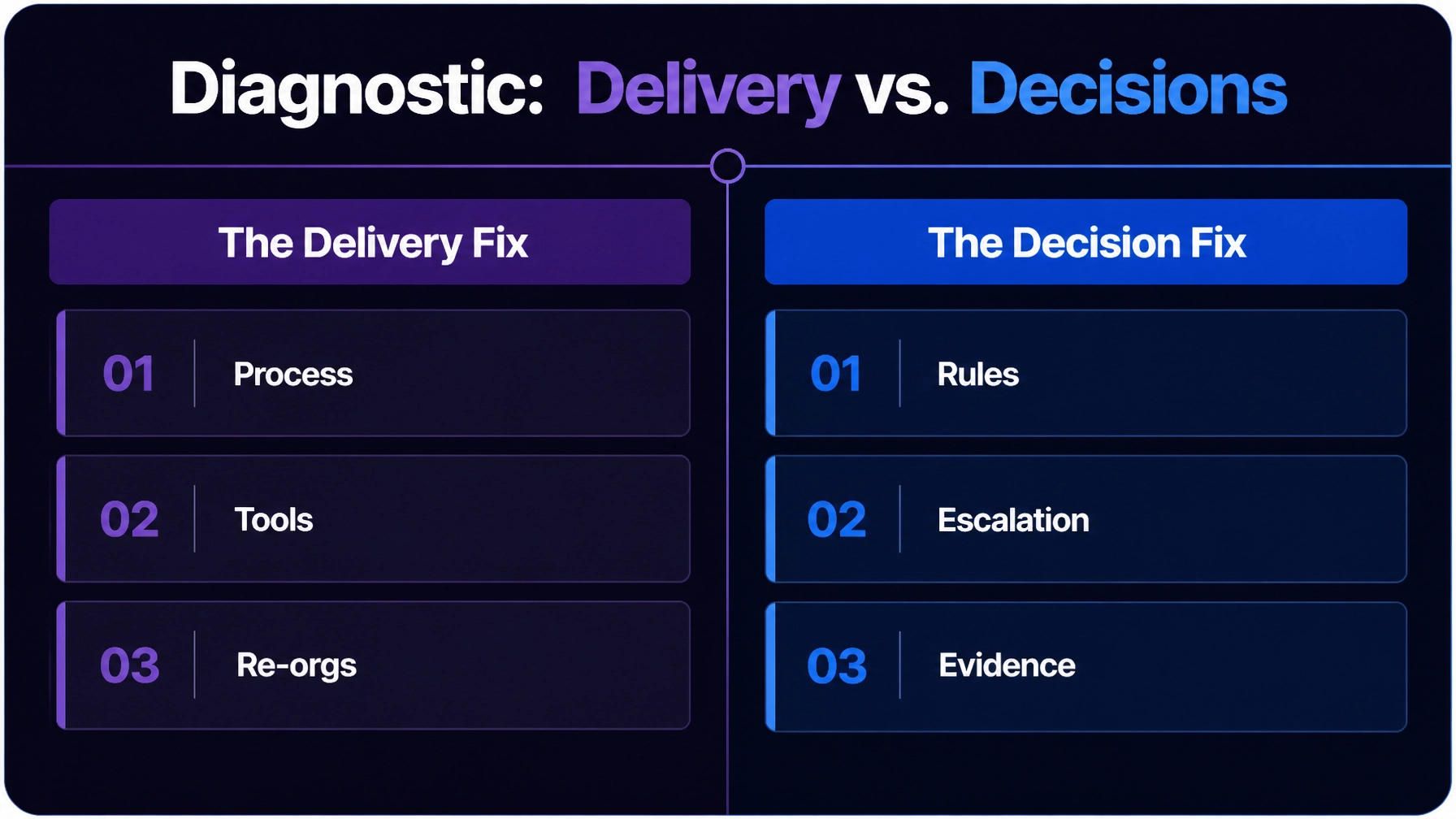
Think about what your fixes actually assume. More process assumes people don't know the steps. Another tool assumes the work isn't visible. A re-org assumes the boxes are in the wrong place. A new hire assumes you're short a person.
But your people know the steps. The work is visible. The boxes are fine. You're not short a person. So you add all of it, and the company gets busier, and the thing you were trying to fix doesn't move. It just hides better.
Here's the uncomfortable version. If more process and more people made it worse instead of better, the problem was never execution. It was the architecture behind the execution.
What actually breaks as you scale
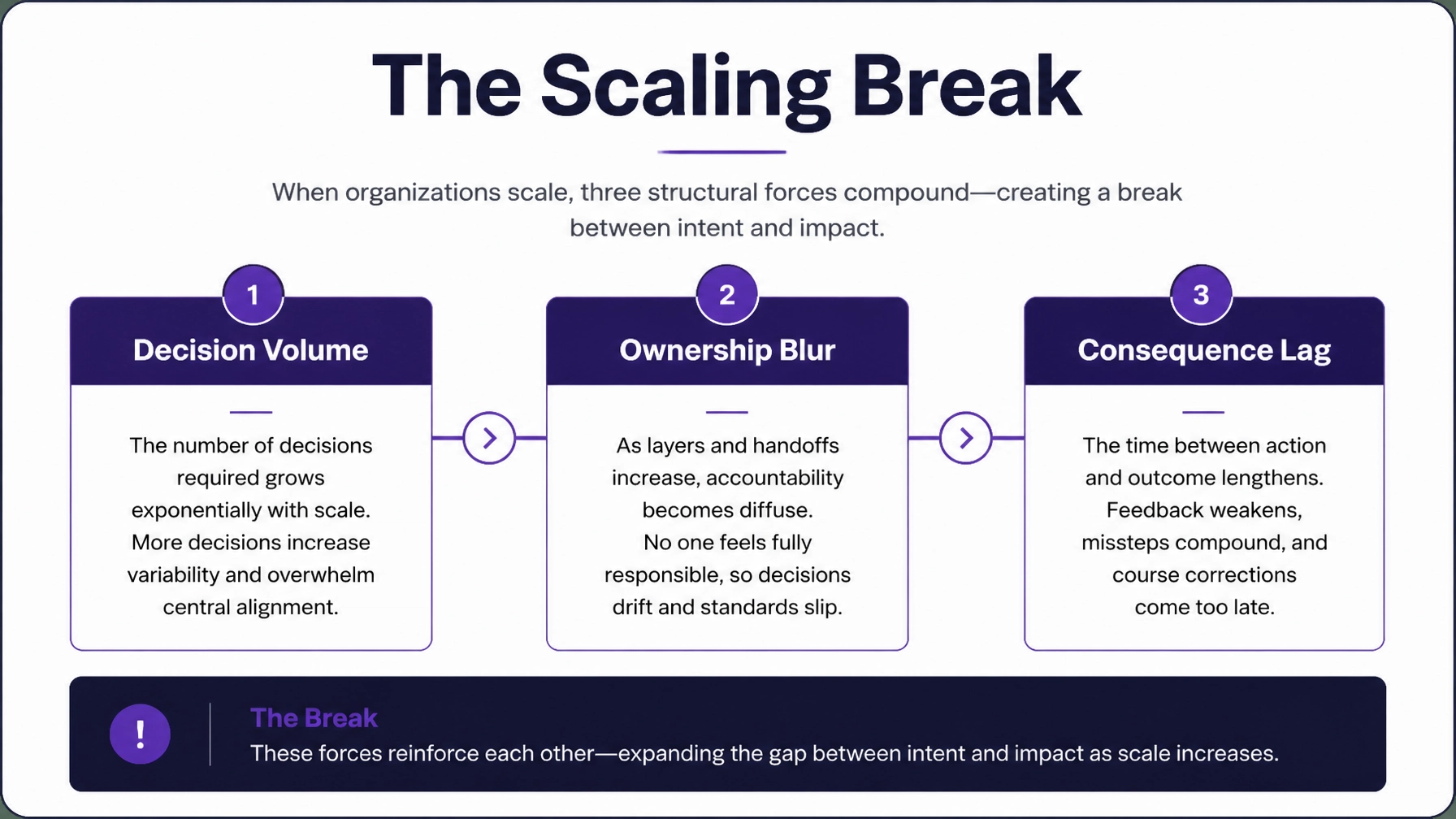
As a company grows, three things change faster than anyone plans for, and none of them are about how hard people work.
Decision volume explodes. It's not just that there are more calls to make. It's that most of them stop feeling like calls at all. They happen in a meeting, in a Slack thread, or by default because nobody picked them up. They get "decided" without anyone deciding.
Decision ownership goes fuzzy. Not because people are dodging it. Because clarity doesn't scale on its own. Two capable people each assume the other one owns the call. Both move. Now you've got two directions and a reconciliation meeting nobody scheduled.
And decision consequences show up late. The bad call you're paying for today got made months ago, in a room you weren't in, and by now it's almost impossible to trace back. So you can't even learn from it cleanly.
Let me give you a real one. At one of the companies I operated inside, we had a handful of business units, and every one of them ran its own KPIs and its own reporting. Sounds harmless. It wasn't. The second two units had to make a joint call, they couldn't agree on whose numbers were even real. Every cross-unit decision turned into a meeting about the metrics instead of a meeting about the decision. And when the metrics meeting stalled, which it always did, the call went up. To leadership. To break a tie that should never have reached them in the first place.
Nobody in that building was lazy. Everybody was working. The units each had reporting they were proud of. And the system still routed a steady stream of decisions upward, because there was no shared answer to a basic question: what counts as enough evidence to decide. When every unit gets to define that for itself, every cross-unit call is a standoff, and standoffs roll uphill.
That's the trap. The activity is real. The motion is real. The progress is mostly theater. And every loose end eventually rolls up to the one person who can't say "not my call." You.
What is Decision Architecture?
Decision Architecture is how your company makes decisions once you're not in every room. It's the set of rules, mostly unwritten, that determines who decides what, when something has to escalate, what counts as enough evidence, and which calls can be reversed and which can't.
Most companies never designed theirs. That's the whole problem. They didn't skip it on purpose. It just never got built, because in the early days it didn't need to exist. Back then the decision architecture was you. You were in every room, so the rules lived in your head, and that worked great right up until it physically couldn't anymore.
Then you scaled. And the thing you never built started deciding for you. Decisions route to whoever's loudest, or whoever's free, or back to you. Escalation happens by vibe. "Enough evidence" means whatever the most nervous person in the room needs to feel okay. Nobody knows which decisions are one-way doors, so they treat all of them like two-way doors and re-litigate everything.
Go back to those business units for a second. The fix there wasn't another dashboard. We'd have just had one more set of numbers to argue about. It was a shared set of decision criteria and review cadences, so leaders were debating strategy on the same footing instead of relitigating whose spreadsheet won. The bespoke reporting each unit loved, some of it we let go. Worth it. Once the vocabulary was shared, the decisions stopped bouncing upward, because the people in the room finally had what they needed to make the call themselves.
And notice where the broken decision actually lived. Not in the org chart. The chart said leadership owned cross-unit calls. In reality the decision was getting made, or not made, down in the gap between two units that had no shared way to settle it. That's the tell. The spot where your architecture is broken is almost never the spot the org chart says it should be. It's in the seams, where ownership was assumed instead of assigned.
What changes when you fix it
The founder I told you about didn't need to work more. He was already maxed. He needed the pile to stop being his.
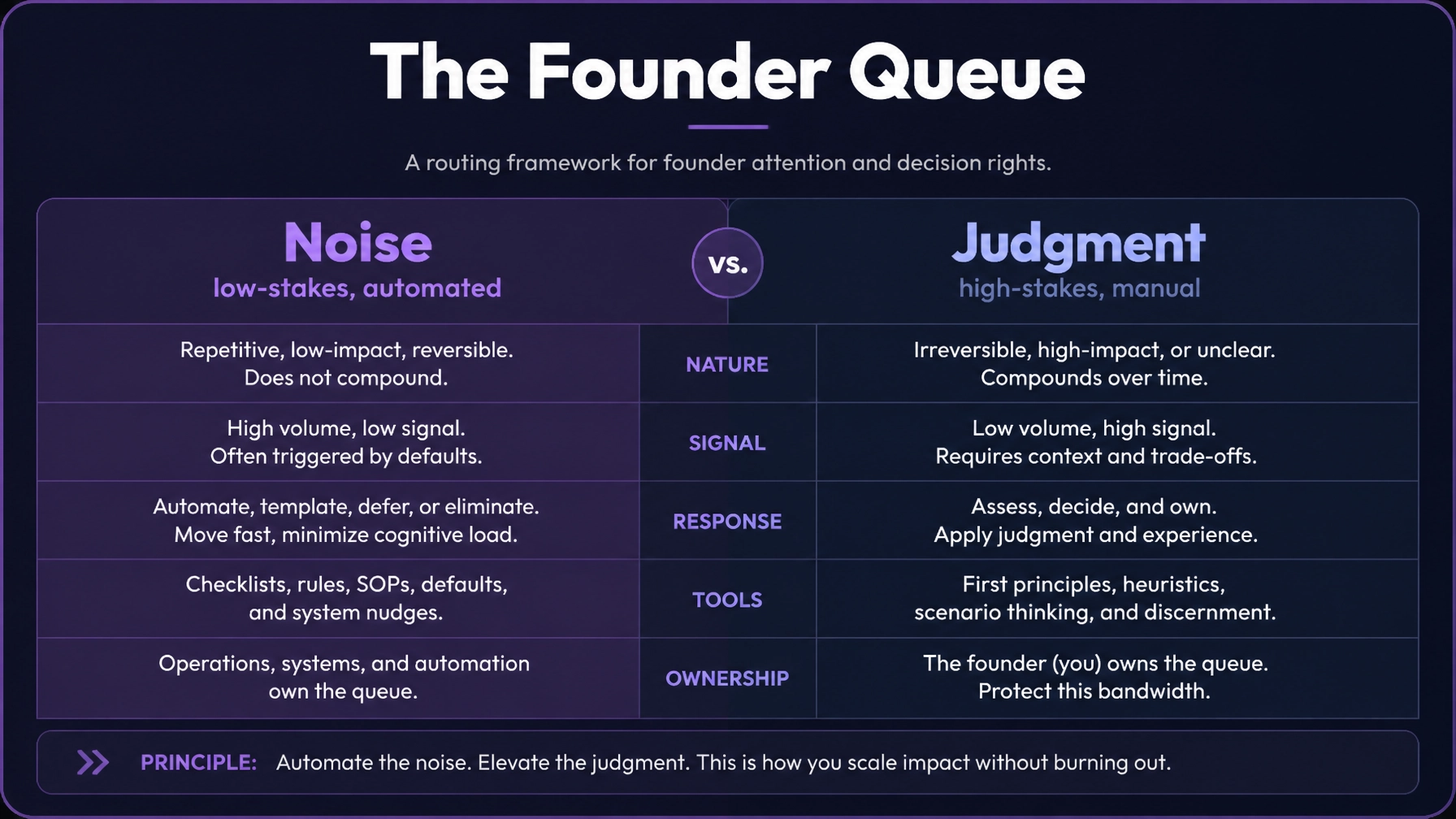
When you fix the architecture instead of the delivery, the shift is fast and it's obvious. Fewer decisions come back up, because ownership is clear enough that people stop bouncing calls to you to feel safe. The ones that do reach you are the real ones, the genuine judgment calls, and you've got room to actually think about them because you're not drowning in the noise that used to ride in alongside them.
Your leaders get faster, not because you pushed them, but because they finally know which calls are theirs to make without checking. Alignment stops resetting every quarter, because decisions are sticking instead of getting re-argued. And the predictability you lost comes back, quietly, the same way it left.
I've run this play. The throughline every time is the same, the company's dependency on founder-driven decision-making drops, and it drops without anyone working a longer day. Notice what didn't happen in any of that. Nobody worked harder. You didn't hire anyone. You didn't buy a tool. You changed how decisions move, and the execution problem you were chasing turned out to be a symptom that just went away on its own.
The real question
So if your company is shipping nonstop and still feels stuck, stop asking why your teams aren't moving faster. They're moving plenty.
Ask where decisions are getting made by default instead of on purpose. Ask which calls keep coming back to you that a clear system would have ended three levels down. That's your constraint. That's the thing quietly taxing every other thing.
Fix that first. Delivery was never the problem. It was just the loudest symptom.
Key Takeaways
Slow execution at scale is usually a decision-making problem rather than a delivery problem.
Adding process, tools, headcount, or a reorganization addresses delivery, so it tends to leave the underlying decision problem in place or make it worse.
Three things break as an organization scales: decision volume rises, decision ownership blurs, and the consequences of poor decisions surface too late to trace.
Decision Architecture is the set of rules for who decides what, what must escalate, what counts as enough evidence, and which decisions are reversible.
Decisions most often break in the seams between teams, where ownership is assumed rather than assigned, not where the org chart indicates.
Most of what reaches a founder is low-stakes noise, which a broken decision system mixes in with the high-judgment calls that genuinely require the founder.
When Decision Architecture is designed deliberately, execution speeds up without added hours or headcount.
Frequently asked questions about Decision Architecture
Why does execution slow down as a company scales?
Because decision-making breaks down faster than delivery does. As an organization grows, the number of decisions rises, ownership of them blurs, and the fallout from poor calls surfaces months later when it is hard to trace. Teams compensate with activity, more meetings and longer roadmaps, which looks like progress while outcomes quietly degrade.
Is slow execution a delivery problem or a decision problem?
Usually a decision problem. When the team already knows the work, the work is visible, and the organization is adequately staffed, adding process or headcount does not address the cause. The constraint is how decisions get made, owned, and enforced, not how the work gets done.
What is Decision Architecture?
Decision Architecture is how a company makes decisions when the founder is not in the room: who owns which call, what has to escalate, what counts as enough evidence, and which decisions are reversible. When it is designed deliberately, execution scales. When it is left accidental, decisions route back to the founder by default.
Why do decisions keep escalating back to the founder or CEO?
Because there is no shared rule for who owns a call or what counts as enough evidence to make it. When ownership is unclear, decisions get pushed upward, and they accumulate with the one person who cannot decline them: the founder or CEO.
Does adding more process or hiring more people fix slow execution?
Rarely, and it often makes things worse. More process, tools, and hires all assume the problem is delivery. When the real problem is the decision system, those additions pile cost and coordination on top of the actual constraint.
How do you stop being the bottleneck as a founder?
The fix is to address what fills the queue rather than clearing it faster. Clear rules for who decides what and what counts as enough evidence let routine decisions resolve lower in the organization, so only genuine judgment calls reach the founder.
Where do decisions actually break in a scaling company?
In the seams between teams, not where the org chart indicates. The chart may assign a call to leadership, but in practice it gets made, or stalls, in the gap between two groups with no shared way to settle it. That gap is usually where the architecture is broken.
I help product leaders at complex product organizations unblock execution when their decision architecture starts breaking down, so that they can ship the roadmap they committed to without another quarter of explanation. If this sounds familiar, you're not alone.
The work is not about moving faster. It is about preserving judgment as systems scale. If you are navigating this right now, book a Relevance Check. We will walk through what you can move first.
No pitch. Just the read.
Clinton Pracher | CP Product Advisory