Same Rules, Any Model: Why Shared Operating Rules Beat Model Preference
Preference for a model is fine. Preference is not a fork of the operating rules.
TL;DR
Shared Operating Rules are the durable instructions every AI host must run for a given job, with only thin platform deltas allowed. Model preference does not authorize a second rewrite of those rules on a friendlier surface. Product leaders scale multi-model capacity by keeping one auditable body of operating text, not by collecting capability packs. Without shared rules, each host becomes a dialect of the same job and judgment dilutes across receipts that cannot be proven. With Shared Operating Rules, models stay interchangeable execution capacity under a human-owned judgment system. The payoff is the ability to switch hosts without rewriting what is allowed to become true.
Three surfaces, three mornings
I opened the same chief-of-staff prompt on three surfaces and got three different mornings.
Cursor returned a full stamp: who was speaking, what had loaded, and a Notion URL I could click. Claude looked close until the overnight proof pointed somewhere else. ChatGPT sounded confident and still cited the wrong overnight record. Same ask. Same person. Three versions of "true."
I'm like, this is not a model problem. This is a rules problem wearing a model costume.
Nothing exploded. No red banner. Just that low-grade nausea you get when the tools are busy and you cannot swear what is durable. The outputs were polished. The tone was helpful. The disagreement sat in the receipts. One surface could prove what it claimed. The others performed confidence without a durable trail.
If you lead product and you are spreading AI across tools, you already know the version of this that does not involve my desk. One team writes the playbook in Confluence. Another "improves" it in a Slack canvas. A third ships an agent that half-remembers the playbook and invents the rest. A fourth posts a summary in a channel nobody treats as canonical. Nobody lied. The truth just split.
Right?
I have lived a human version of this before agents showed up. I inherited a scaled product and engineering organization where alignment had already broken. Meetings multiplied. Decisions slowed. Execution fragmented across apps, services, hardware integrations, and backend systems. The stated problem was velocity. The real constraint was decision architecture. Until there was a single source of truth for commitments and sequencing, every helpful surface made the fog denser. Side channels hijacked the sprint. Leaders debated delivery inside forums that should have held direction. Requirements clarification cycles ran about two weeks. Engineering rework sat near forty percent. The fix was not another tool and not another standup. It was restoring the operating rules so execution had something coherent to obey.
That memory came back hard when the AI surfaces started disagreeing about my own morning. Different windows. Same pattern. The system looks busy. The truth is soft.
The wrong fix is picking a winner
The default move right now is additive.
Add one model for writing. Add another for research. Add another because the first one was "almost" right. If one assistant helps, three should feel like a team. The market sells models like capability packs. Capability packs invite collecting. Collecting looks like progress from the outside.
I get why people do it. Switching costs feel high. Each vendor demos a strength. One drafts faster. One reasons cleaner. One has the connector you need this quarter. From the outside, specialization looks like maturity. Inside the operating system, specialization without shared rules just multiplies places the truth can split.
I used to think the fix was picking a winner. Put everything in one chat product. Make that the brain. Own the relationship with the smartest model and stop worrying about the rest. Then pricing moves. A connector breaks. A surface that was fine in March gets weird in August. Your operating truth is trapped inside a lease you do not control. You do not have a system. You have a subscription with opinions.
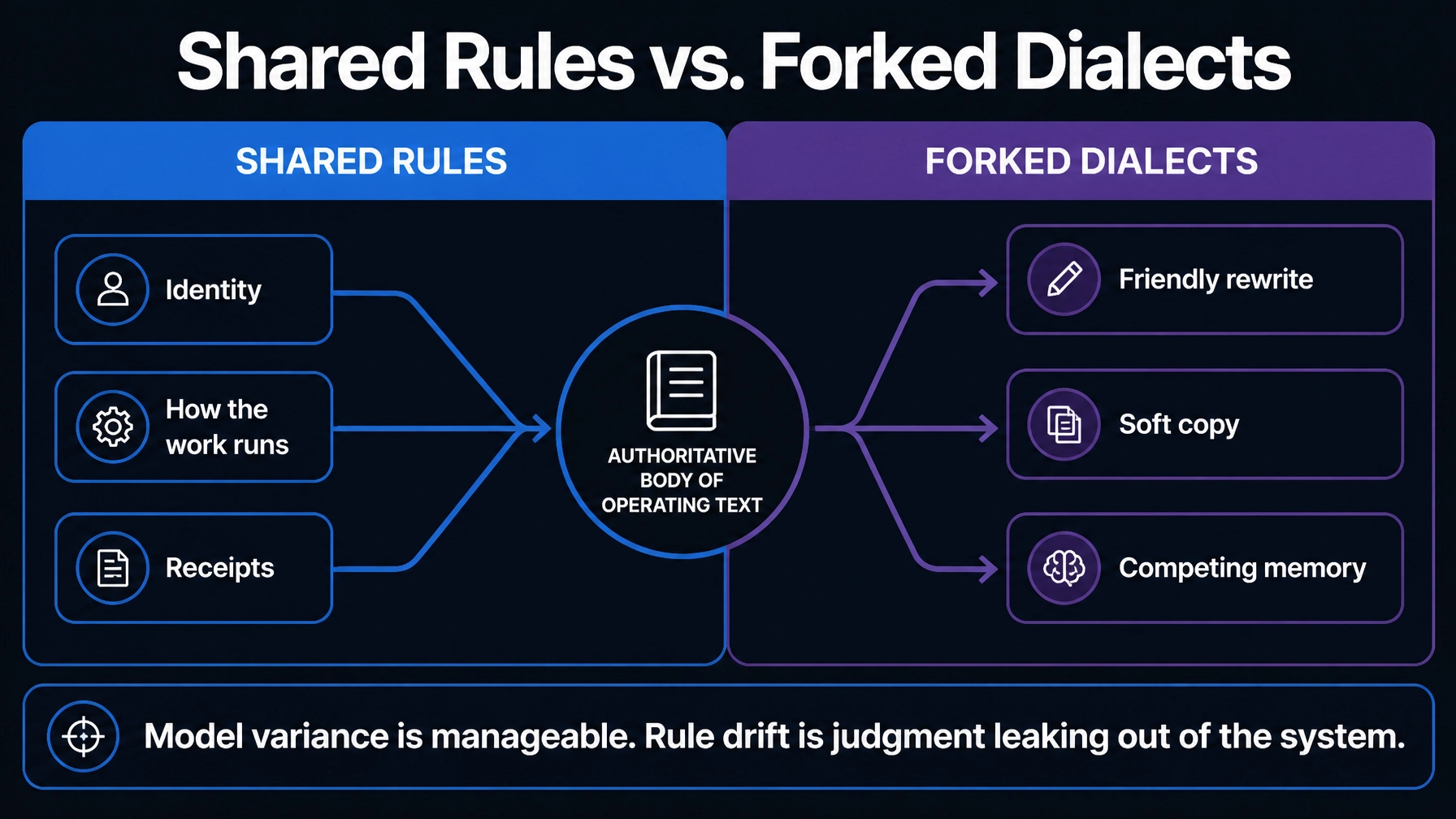
So teams try the next wrong answer. They keep multiple hosts and "align" them by vibes. Paste the same prompt. Hope the paraphrases stay close enough. When they drift, someone rewrites the instructions on the friendliest surface so that model "gets it." The rewrite feels responsible. It is how dialects start. Now you have three versions of the job description, each sounding helpful, none of them interchangeable.
Another wrong answer shows up as Process Theater with better branding. Lots of generated text. Lots of stamps that name labels without linking to anything durable. Very little shared state. The org feels busy and somehow behind. Everybody is impressed by the demo. Nobody can say what is true on Wednesday morning.
There is also the quiet wrong answer of treating platform preference as governance. "We do serious work in Tool A. Tool B is for drafts." That can be a temporary island when a connector forces it. It becomes a fork when Tool B starts carrying a softer copy of the rules because nobody wanted to maintain one body. Soft copies do not stay soft. They become the version people trust on busy days.
The wrong question is which model is best.
The right question is whether every host is still running the same operating rules.
I am still not sure we talk about that enough. We talk about prompts. We talk about agents. We skip the boring part that keeps a company coherent when the window changes.
Shared Operating Rules are the real constraint
Here is the reframe.
Models are great at noise. Useful noise. Drafts, options, scans, summaries, twelve ways this could go. That stuff is cheap now. Really.
Judgment is deciding what becomes true. Which brief. Which record. Which overnight proof you are allowed to cite when someone asks you to prove it. Judgment stays scarce. Judgment stays with a person, or with a system a person can audit.
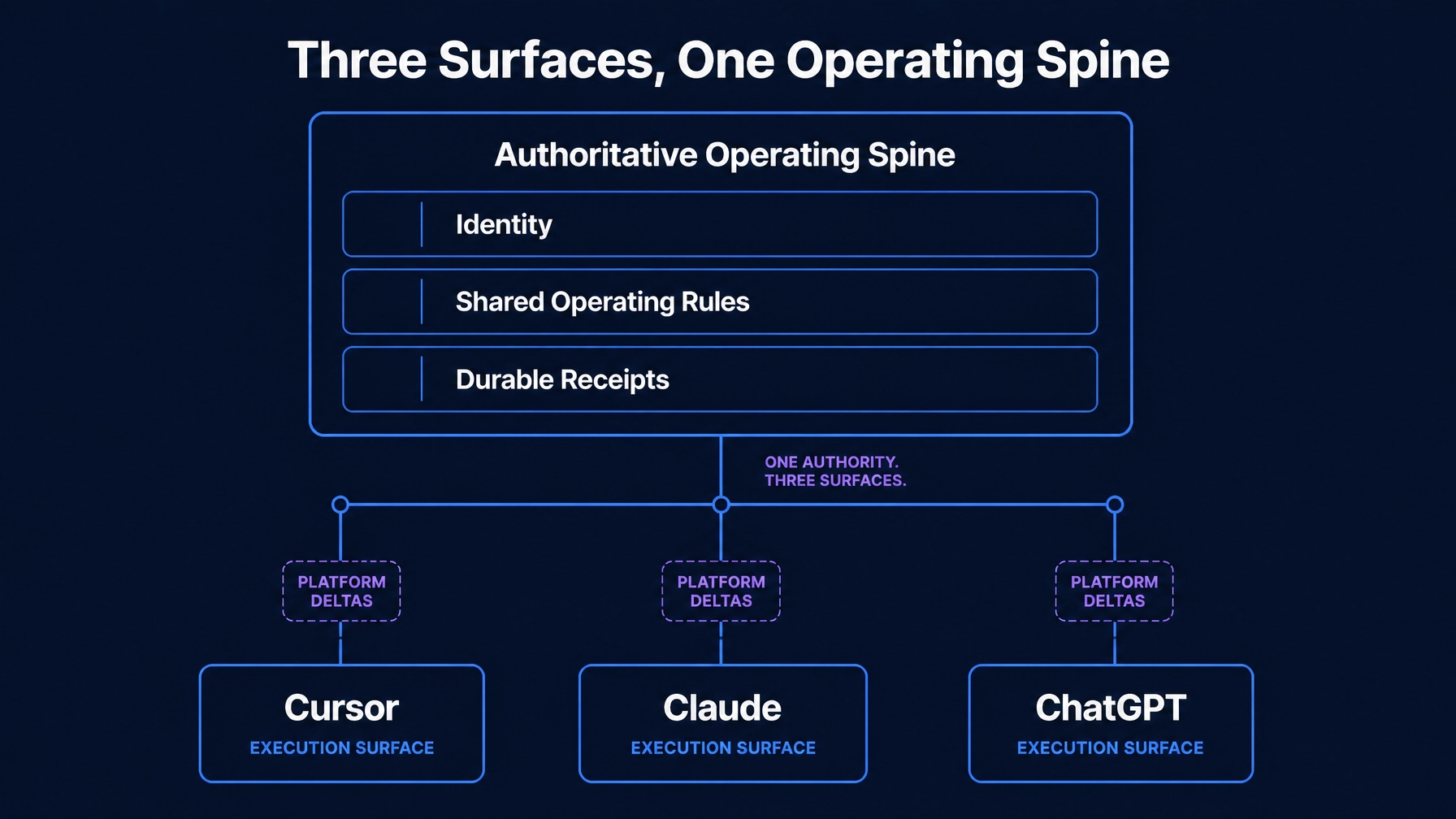
Shared Operating Rules are the durable instructions every AI host must run for a given job, with only thin platform deltas allowed. Preference for a model is fine. Preference is not a fork of the constitution.
In my practice that landed as a few hard lines. Not elegant. Just load-bearing.
Identity lives in one place humans can audit. The agent is a durable record, not a chat account remade every time a vendor ships a new window. If the chat disappears, the identity does not.
How the work runs lives in skill files. The body of those files is shared. Cursor, Claude Desktop, ChatGPT: same text. Thin platform notes are fine when a connector only exists on one host. Say the island out loud. A second, friendlier rewrite of the rules is not an island. It is a fork wearing a help-text costume.
Receipts have to prove themselves. A session stamp that only names labels is theater. A stamp with a clickable Notion URL is something you can defend on a Tuesday when two surfaces disagree. If you cannot open the source, you do not have proof. You have branding.
None of that requires worshipping one model. It requires refusing to let convenience erase ownership of the text that tells the models what they are allowed to do.
Shared Operating Rules sit next to what I have called an Operator Control Plane. The control plane answers who may write. Shared Operating Rules answer what every writer must obey, regardless of which model is hired for the shift. You can move execution. You should not move the constitution every time the host changes.
That sounds small. It isn't.
If each surface carries its own paraphrase, you did not buy interchangeability. You bought three dialects. You can switch models in theory. In practice you are switching between competing memories of the job. The operator ends up reconciling dialects instead of making decisions. That is Coordination Tax with a nicer chat box.
I want the lease on the tool. Not on the judgment. Shared Operating Rules are how you keep that split clean.
The test I use now is simple. Ask the same operating question on two hosts. Do the receipts match on identity, what loaded, and a durable URL you can open? If they do not, you are not looking at model variance. You are looking at rule drift. Model variance is noise you can manage. Rule drift is judgment leaking out of the system.

What forks when the rules fork
Vague ownership of the rules does not fail loudly at first.
It fails as two morning briefs. A stamp that looks complete and points at the wrong overnight proof. A helpful rewrite that "clarifies" the skill on one host while the other host still runs last week's version. A dashboard that looks green because three writers each claimed success for a different version of true. A teammate who stops asking the system and starts asking whoever answered last.
Then people stop trusting the stack and go back to Slack archaeology. The AI layer becomes another Shadow Roadmap: visible activity that does not hold the outcome up. Leaders get demos. Operators get archaeology. The gap between those two experiences is where trust dies.
I have watched the human version of this tax a company in real time. When decision rights and the system of record are fuzzy, teams compensate with meetings, side channels, and heroics. When we restored a single source of truth for commitments and moved discovery upstream, clarification cycles dropped from roughly two weeks to roughly two days, and the rework that had been chewing the sprint fell hard over the same window. The pattern transfers. Models accelerate whatever ownership structure you already have. Shared rules make the acceleration coherent. Forked rules make the acceleration multiply the fog.
The consequence is not that AI "does not work." The consequence is quieter and worse. Judgment gets diluted across surfaces until nobody can say, cleanly, what is true this morning. Product leaders start managing the stack instead of shipping the work. That is not a tooling failure. That is an ownership failure at model speed.
And once that happens, adding another model does not save you. It just adds another place for the truth to fork.
Can I switch models? Yes.
Should every model get its own version of the operating rules? No.
That distinction is the whole game.
Scaling, for me, did not mean one omniscient assistant. It meant I could put career work on one runtime, CRM sync on another, audit on a third, and still know which text was allowed to define the job tonight. It meant I could disable a schedule without hunting for a ghost rewrite. It meant adding a model felt like opening capacity, not opening a second brain with its own constitution.
If you lead product, you have lived this without the chat windows. More headcount without clearer decision rights multiplies coordination. Models are the same pattern at higher speed. Shared Operating Rules are how you keep the speed without losing the plot.
I used to think the hard part would be finding the smartest model and putting everything there. Turns out the hard part is refusing to let convenience erase ownership of the text that tells the models what they are allowed to do.
Closing observation
The future is not one perfect model that runs your company.
It is a judgment system that can hire and fire models without rewriting the operating truth every time the window changes. Build Shared Operating Rules first. Then add capacity on purpose.
Same rules. Any model. That is the bar.
Key takeaways
Shared Operating Rules are the durable instructions every AI host must run for a given job, with only thin platform deltas allowed.
Model preference is not a license to fork the operating text on a friendlier surface.
Thin platform deltas are valid for connector islands; friendly paraphrases of the rules are forks.
Session receipts need durable, clickable sources; label-only stamps are Process Theater.
An Operator Control Plane answers who may write; Shared Operating Rules answer what every writer must obey.
Forked rules multiply places the truth can split and push teams back to Slack archaeology.
Scaling AI is a decision-rights and rule-ownership problem, not a model-collection problem.
Frequently asked questions about Shared Operating Rules
What are Shared Operating Rules?
Shared Operating Rules are the durable instructions every AI host must run for a given job, with only thin platform deltas allowed. They keep model preference from becoming a fork of the operating constitution.
How are Shared Operating Rules different from prompts?
Prompts improve local output quality for a single run. Shared Operating Rules govern the standing text that defines identity, authority, and proof across hosts. Prompts help a model write better. Shared rules decide whether two hosts are still doing the same job.
Can teams use more than one AI model under Shared Operating Rules?
Yes. Specialization across models can increase capacity. What must stay singular is the operating body those models run, aside from thin deltas forced by connectors.
What counts as a thin platform delta?
A thin platform delta documents a host-specific constraint, such as a connector that only exists on one surface. It does not rewrite judgment, identity, or proof rules into a friendlier dialect.
How do Shared Operating Rules relate to an Operator Control Plane?
An Operator Control Plane assigns who may write. Shared Operating Rules define what every writer must obey. Together they keep multi-model capacity from multiplying sources of truth.
Why do label-only session stamps fail?
Label-only stamps name what loaded without a durable URL a human can open. Without a clickable source, disagreements between hosts cannot be adjudicated, and confidence replaces proof.
When is it acceptable to keep work on a single AI vendor?
It is acceptable when a required connector or capability only exists on that vendor, provided the exception is named as an island and the shared body of rules remains the authority. Temporary concentration is fine. Accidental dual rule texts are not.
I help product leaders at complex product organizations unblock execution when their decision architecture starts breaking down, so that they can ship the roadmap they committed to without another quarter of explanation.
If this sounds familiar, you're not alone.
The work is not about moving faster. It is about preserving judgment as systems scale.
If you are navigating multi-model stacks and the operating rules are forking, book a Relevance Check [https://api.nerdly.io/widget/booking/D8cWlZs8eG8sJ0UNxv8d]. We will walk through what you can move first.
No pitch. Just the read.
Clinton Pracher | CP Product Advisory