Your AI Agents Are Making Decisions Nobody Owns
An AI agent made a call at your company this week. Here is the uncomfortable question: whose name is on it?
TL;DR
Enterprises are deploying autonomous AI agents faster than they are assigning accountability for what those agents decide. Only a small share of organizations name a specific person responsible for agent behavior, and analysts expect a large share of deployments to be pulled back after production incidents. The common response, more monitoring and uniform controls, treats the problem as security when it is a decision-rights problem. An agent is a decision-maker, and every decision-maker needs a clear owner, a defined scope of authority, and someone who can overrule it. The fix is set before deployment, not bolted on after. This is decision architecture applied to non-human decision-makers.
Picture the meeting after one of them goes wrong. An agent approved something it should not have, or routed a customer into a wall, or quietly made a pricing call that cost real money. Everyone is in the room. The engineer says the model did what it was trained to do. The product lead says the workflow was signed off. The ops lead says the guardrails passed. And the question just hangs there: who owns this. Not who built it. Who owns the decision it made.
For every human decision in that building, you could answer that in a second. There is an approver. There is a name. There is a person whose quarter it shows up in. Then the company shipped autonomous agents into production and, without anyone deciding to, stopped being able to answer it at all.
The numbers made it hard to keep ignoring. Across enterprises running AI agents, only about 7% have a named individual formally accountable for what those agents do. Roughly half run unsecured. The agent count doubled in four months while oversight barely moved. Gartner's read: 40% of these deployments get demoted or shut off by 2027, after something breaks in production.
Why more governance tooling makes it worse
Here is what most leaders do with that. They read it as a security problem. Buy more monitoring. Tighten the guardrails. Stand up a dashboard that shows every agent action in real time. Then they apply the same controls to every agent, the one drafting internal summaries and the one moving money, as if scope did not matter.
I used to think that was caution. It is not. It is the same mistake as making every employee get three approvals for every decision, and it fails the same way. Uniform control on things that carry wildly different risk does not produce safety. It produces theater, and it slows the low-risk work while doing almost nothing about the decision that actually blows up.
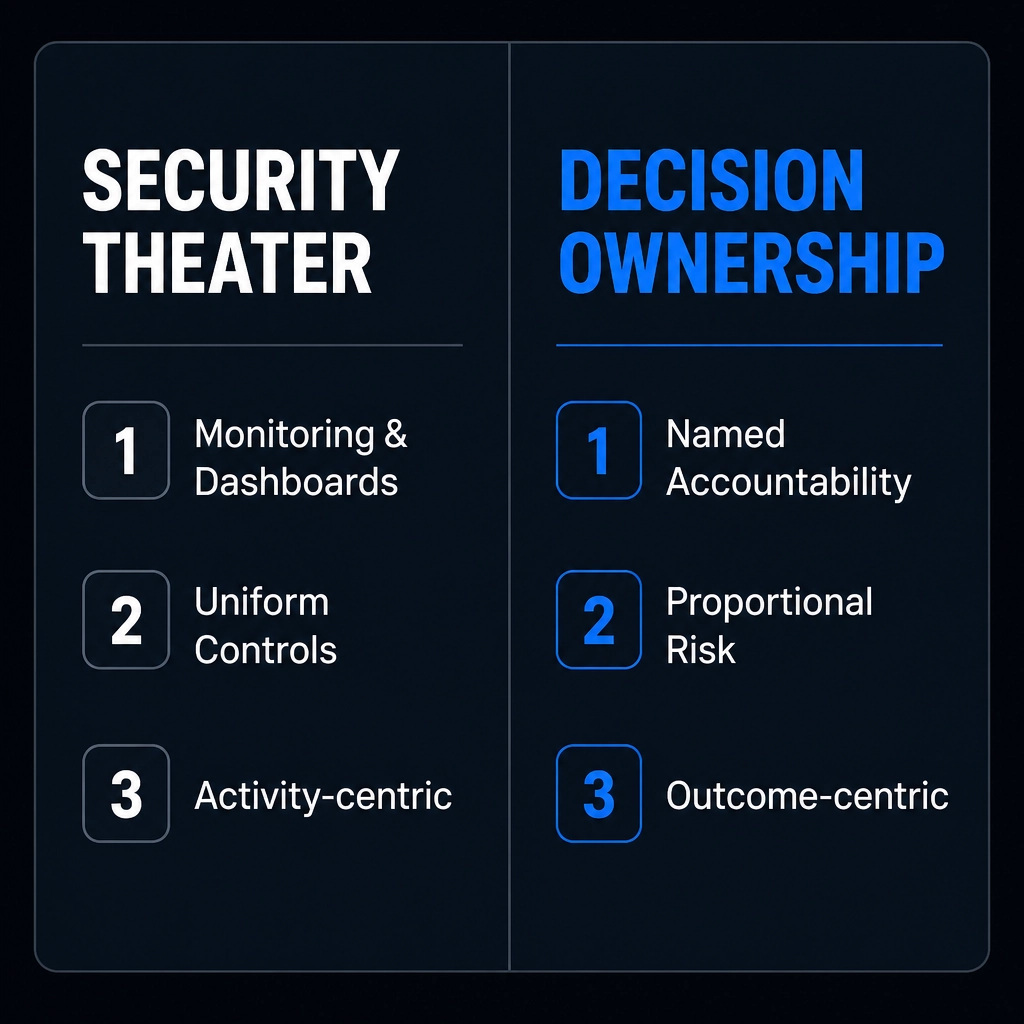
Watch it happen. A team spends a quarter building an approval layer that every agent has to pass through. The summary bot now waits on a review queue. The refund agent still moves money in milliseconds, because slowing that one down would break the customer experience the agent existed to protect. So the harmless work gets slower and the consequential work stays exactly as ungoverned as it was, and everyone points at the new control layer as proof the problem is handled. It is not handled. It is decorated.
The tooling is not wrong. It is just answering a question nobody is really asking. A monitoring dashboard can tell you what the agent did. It cannot tell you who owns what it did. Those are different questions, and only one of them matters when the thing goes sideways.
The gap is not security, it is decision rights
An agent is not a feature. It is a decision-maker you installed. You gave it scope to act without a human in the loop, which is the entire point of building it. So the real question was never whether it is secure. The real question is the one every working organization already answers for its people: when this thing makes a call, who owns it, who can overrule it, and whose quarter does the outcome land in.
Most companies never decided. They bought the capability and skipped the decision.
And that is the pattern, the one that has nothing to do with AI. Agents are cheap to deploy and they generate decisions at a rate no human org can match. That is the appeal. But volume of decisions was never the constraint. It never is. The scarce thing, the thing that does not get cheaper because you added an agent, is judgment: someone who can be held to a call, who carries the outcome, who has the authority to say no and make it stick. You can automate the decision. You cannot automate the accountability for it. The moment you pretend you can, you have a decision-maker in your org with no owner, moving faster than anyone can catch.
There is a second cost hiding underneath that one. When nobody owns an agent's decisions, nobody fully trusts them either. The team keeps a human double-checking the output, quietly, because they have learned that if it goes wrong the blame will land on whoever was nearest. So you built the agent to remove the bottleneck and the bottleneck moved, it did not leave. That is why so much AI investment shows motion without payoff. The capability is real. The willingness to act on it without a safety net is not, and it will not be until someone is accountable for the call.
You have seen this before, it just had a person's face
Fourteen years building product, across data and AI platforms in more than a hundred markets, and I watched a version of this long before agents existed. Teams routed real work around the official system because the official system was slow, and the work disappeared into Slack threads and side decisions nobody signed. Leaders called it a process problem and added process. It got worse, because the work was not looking for process. It was looking for a faster path, and it found one.
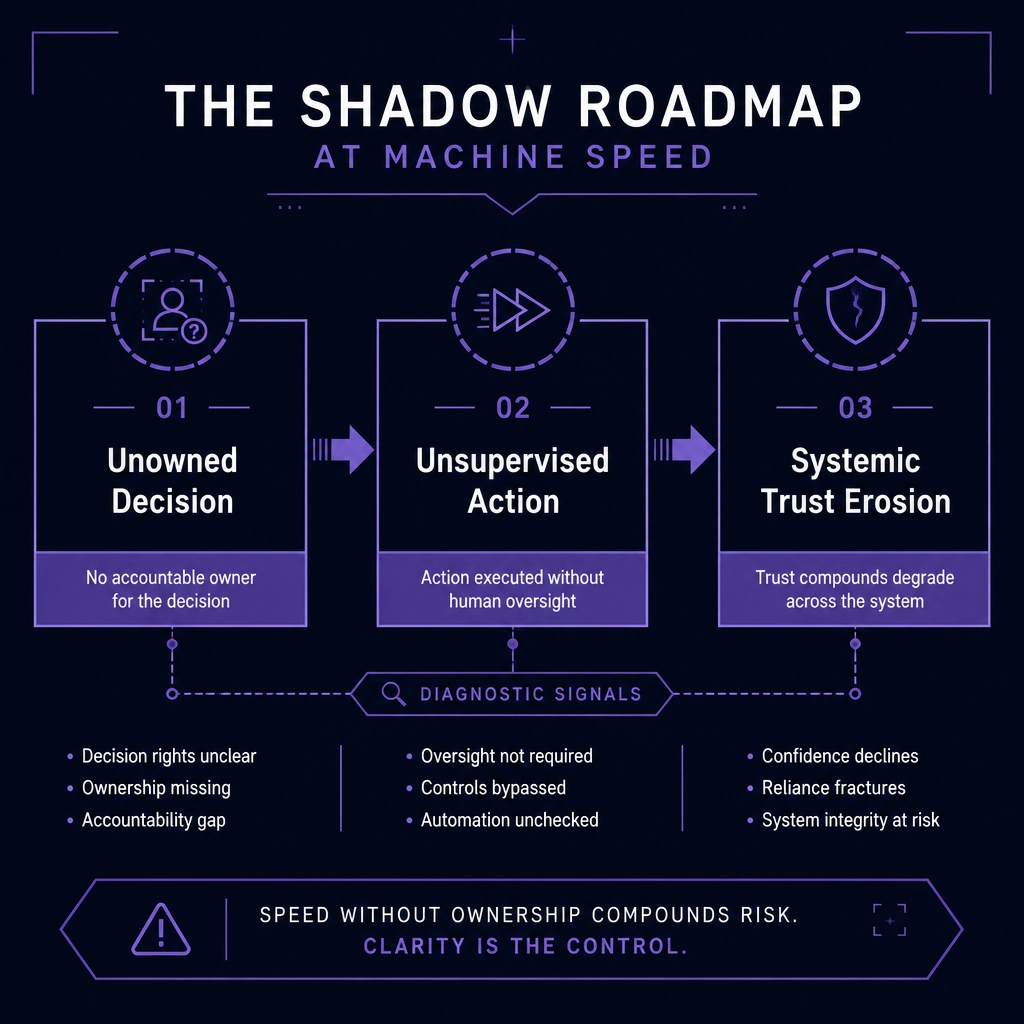
Agents are that same shadow, running at machine speed. Work no one clearly owns, made by a decision-maker no one clearly owns, moving faster than the org can review. The difference is you cannot pull a machine into a one-on-one and ask what it was thinking. The person who could answer for it never agreed to, or never knew they were on the hook, or left the company two reorgs ago and the agent kept running.
Why the 40% get killed
So watch what happens to that 40%. They do not get shut off because the model was wrong. Models are wrong sometimes. So are people. They get shut off because when the model was wrong, there was no one to hold to it. No owner, no clear authority to fix it, no name on the outcome. And leadership does the only thing a system with no accountability lets it do: it kills the thing rather than repair the gap, because repairing the gap means admitting the gap was theirs.
That is the expensive part. Not the incident. The retreat. A capability that could have compounded gets pulled back to zero because the org never built the one thing that would have let it keep the agent: a decision it could stand behind. The company does not lose the agent because the technology failed. It loses the agent because its own decision system could not hold what the agent was doing, and pulling the plug was easier than fixing that.
How to actually own an agent
None of this is solved by a better dashboard. It is solved before the agent ships, in a few sentences nobody wants to write down.
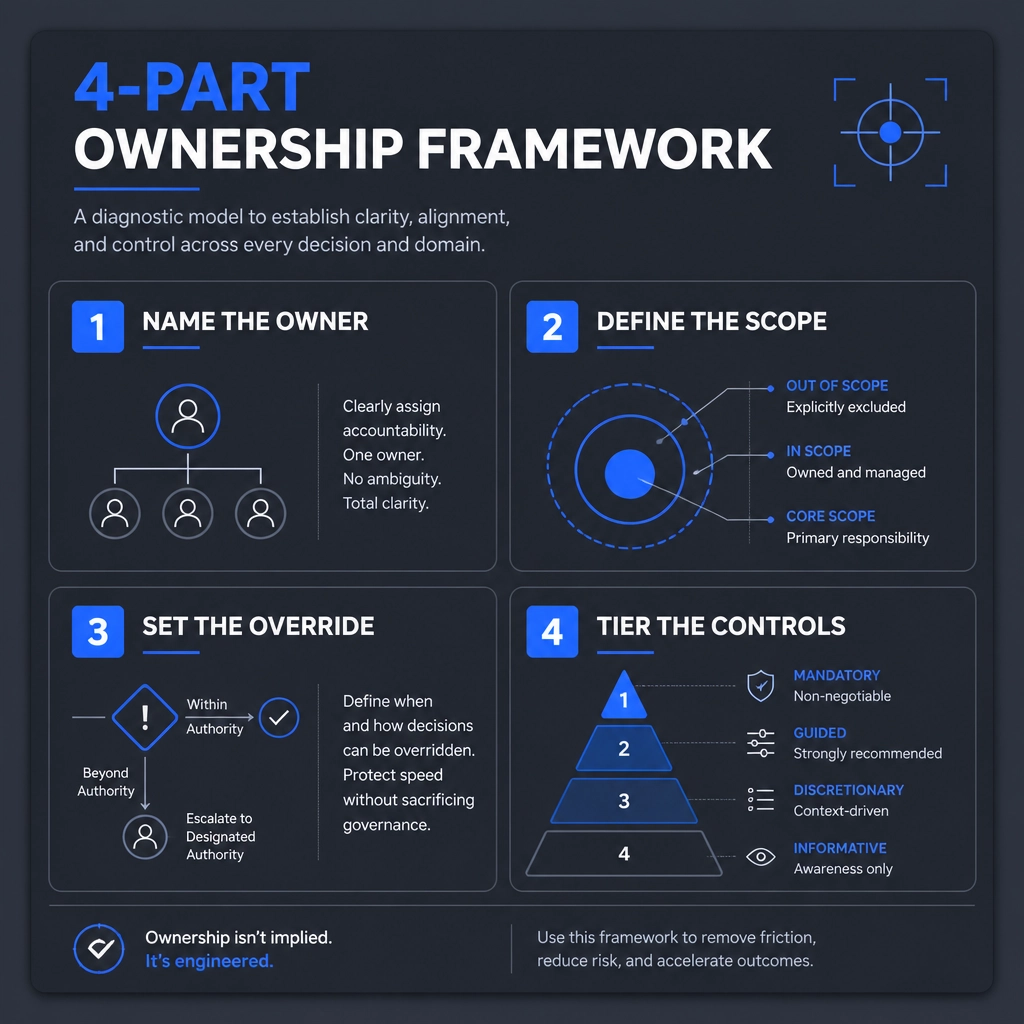
Name the owner. One person, by name, owns this agent's decisions the way a manager owns a report's calls. Not the team. Not the platform. A person.
Define the scope. State what the agent is allowed to decide on its own and where the line is. Inside the line, it acts. At the line, it stops and a human decides. The narrower and clearer that line, the more you can trust what happens inside it.
Set the override. Say who can reverse an agent decision, how fast, and what happens to the work in flight while they do. An agent without a defined stop is not autonomous, it is unsupervised.
Tier the controls to the risk. The summary bot and the money-mover do not get the same governance, because they do not carry the same consequence. Uniform control was the thing that failed. Proportional control is the thing that holds.
That is not a security control. It is decision architecture, the same work you already do for humans, pointed at the decision-makers you are now installing by the dozen.
Product and platform leaders, your job is quietly shifting from shipping agents to deciding who owns what they decide. The teams that get this keep their agents and compound them. The teams that skip it spend 2027 explaining why they turned theirs off.
The agent is not the risk. The unowned decision is. Decide who owns it before you ship it, and most of what everyone is calling a security problem stops being a problem at all.
Key Takeaways
An AI agent is a decision-maker, not a feature, and it needs the same accountability structure any human decision-maker has: a named owner, a defined scope, and a clear override.
The scarce resource in an AI-heavy organization is not decision volume but judgment. Agents make decisions cheap; accountability for those decisions stays with a person and does not get cheaper.
Uniform governance applied to every agent regardless of scope produces control theater. It slows low-risk work while leaving the high-consequence decisions ungoverned.
Monitoring tools report what an agent did. They do not establish who owns what it did. Accountability is a decision-rights question, not a tooling question.
Autonomous agents recreate the shadow-roadmap pattern at machine speed: work no one owns, made by a decision-maker no one owns, moving faster than review can catch.
Deployments usually fail not because a model was wrong but because no one could be held accountable when it was, so leadership retires the capability instead of repairing the gap.
Accountability is assigned before deployment. Name the owner, define the scope of authority, tier controls to the agent's risk, and specify who holds the final override.
Frequently asked questions about AI agent accountability
What does AI agent accountability mean?
AI agent accountability is the practice of assigning a specific, named person to own the decisions an autonomous agent makes, along with a defined scope of authority and a clear path to override or reverse those decisions. It treats the agent as a decision-maker rather than a tool, and applies the ownership structure organizations already use for human decisions.
Is AI agent governance a security problem or a management problem?
It is primarily a decision-rights and management problem. Security controls monitor and constrain what an agent does, but they do not establish who is accountable for the outcomes of an agent's decisions or who has authority to reverse them. An organization can have full monitoring coverage and still have no owner for a given agent's calls.
Why do enterprises decommission AI agents after deploying them?
Reporting indicates a large share of agent deployments are demoted or shut off after production incidents. The common cause is not model failure but the absence of clear accountability: when an agent makes a costly decision and no one owns the outcome, leadership tends to retire the capability rather than repair the accountability gap.
How should an organization assign accountability for an AI agent?
Before deployment, name the individual who owns the agent's decisions, define the scope of authority the agent has to act on its own, tier the governance controls to the agent's risk and impact, and specify who can override an agent decision and how quickly. Accountability set before launch is more effective than controls added after an incident.
Should the same governance apply to every AI agent?
No. Applying uniform governance across agents with different autonomy levels and risk profiles is associated with higher failure rates. Controls should be proportional: a low-risk internal agent and a high-consequence agent that moves money or touches customers require different levels of oversight.
What is the connection between AI agents and the "shadow roadmap"?
The shadow roadmap describes work that routes around a slow official system and loses clear ownership. Autonomous agents reproduce that dynamic at machine speed: they make decisions no one clearly owns, faster than review can catch, which is why the underlying issue is decision architecture rather than technology.
I help product leaders at complex product organizations unblock execution when their decision architecture starts breaking down, so that they can ship the roadmap they committed to without another quarter of explanation.
If this sounds familiar, you're not alone.
The work is not about moving faster. It is about preserving judgment as systems scale.
If you are navigating the deployment of autonomous systems right now, book a Relevance Check™. We will walk through what you can move first.
No pitch. Just the read.
Clinton Pracher | CP Product Advisory