A Company That Catches Itself: Building a Self-Healing Company
I built my company to explain itself without me in the room. This is the morning I found out whether it could.
TL;DR
A self-healing company is an organization built to detect its own problems, correct the ones it can, and route the rest to a human for a decision, instead of depending on one person's attention to hold it together. It is the operating expression of decision architecture: the structure that determines who owns what, how tradeoffs surface, and whether commitments hold as an organization scales. Most companies run on memory and heroics until growth exposes the gaps; a self-healing company writes its decisions down, grades its own health, and surfaces risk before it becomes a crisis. This piece is a first-person account of why CP Product Advisory was built self-healing from the start, what that architecture looks like in practice, and the failure that revealed its final missing piece. The through line is that judgment, not speed, is the scarce resource a growing company has to protect.
I did not start this company because I wanted to be a founder. I got laid off, and I did not want to go back to the same conditions that broke me in the first place.
For years I built product inside scaling organizations. Infrastructure, data platforms, operating models. The plumbing that decides whether a company can actually grow or just gets busier. I watched seven of them scale from the inside, and the thing that broke was never the work. It was the organization underneath the work.
Memory fails. People leave. Context walks out the door. Small gaps sit unseen in the dark until they surface as a crisis nobody saw coming. Everything feels urgent, nothing feels stable, and the business needs constant attention just to keep from drifting. I have sat in that room more times than I can count. The founder is not there because execution is broken. The founder is there because the company can no longer see itself, and someone has to hold the whole picture in their head. Usually the most senior person in the building. Usually right up until they burn out or walk.
The fix that never fixes anything
And the fix is always the same. A new framework. A new methodology. A new set of rituals, laid down on top of a structure that is already cracked. Companies swing between too little structure and too much of it, chaos or calcification, and neither one scales. I started calling it process theater. Activity standing in for clarity. Working sessions that feel productive but exist because nobody can make a decision and make it hold. Everyone performs the ceremony of fixing the problem and never touches the thing that is actually broken. You cannot framework your way out of a structural fracture. I have watched a lot of smart people try, and it fails the same way every time.
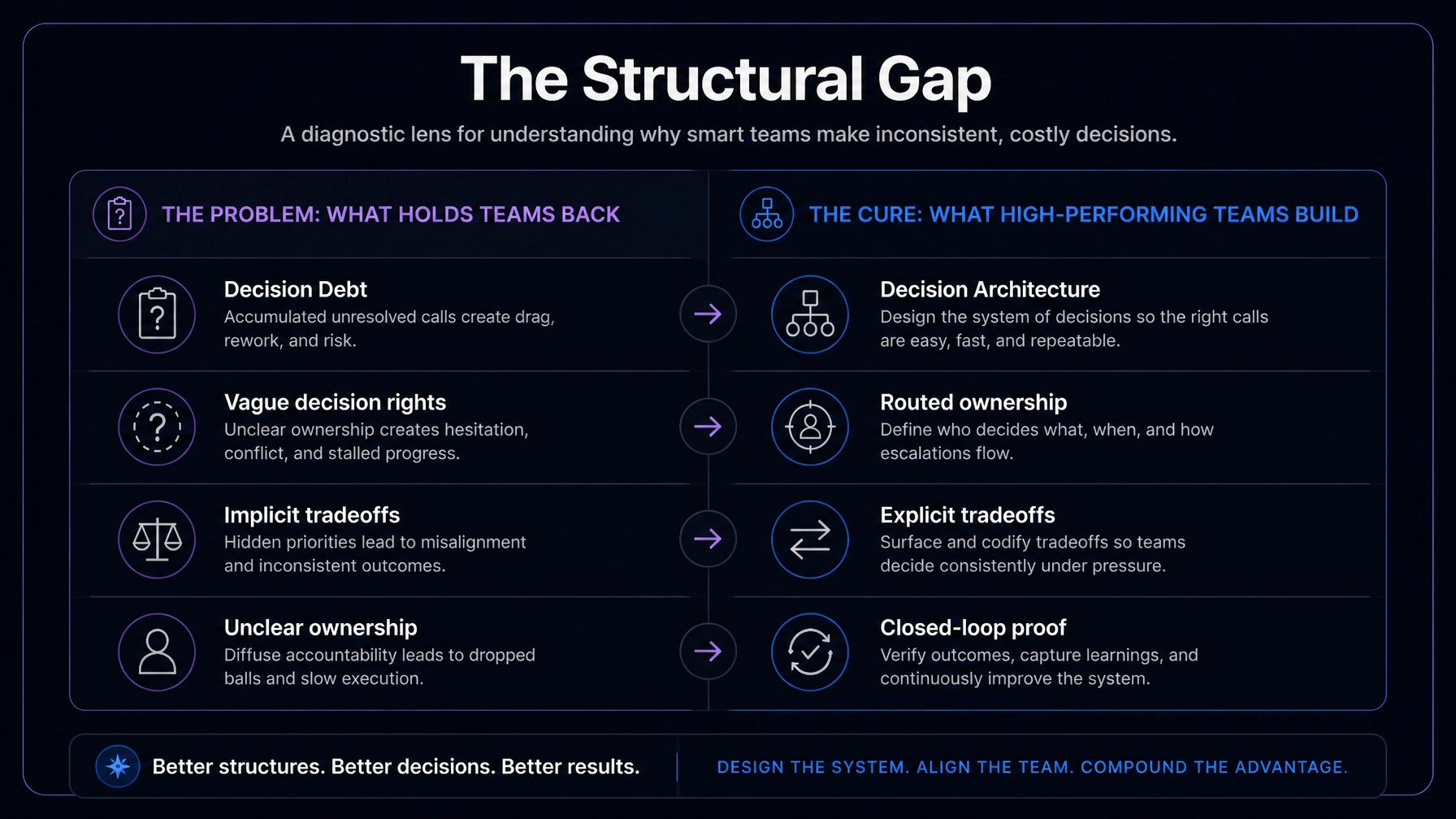
So I started CP Product Advisory to name the thing instead of selling the ceremony. And the thing has a name. Most execution problems are not execution problems. They are decision problems. Vague decision rights, implicit tradeoffs, unclear ownership, no forcing function to close a loop with proof. What a company is actually missing when it feels like this is decision architecture. The operating system for judgment under load. The structure that decides who owns what, how tradeoffs get surfaced, where commitments get made, and whether they hold when things get messy. Most companies do not have it. They have decision debt. A backlog of unresolved calls and deferred tradeoffs and ambiguous ownership that quietly piles up until every conversation is a negotiation. Leadership reads this as an execution problem. They hire for talent. They add checkpoints. Nothing changes, because the real constraint was never talent. It was architecture.
And it gets worse the bigger you get. Scale multiplies coordination cost. The number of decisions that depend on other decisions explodes, and what used to be a quick conversation now needs alignment across six teams. Good judgment stops being enough, not because the people got worse, but because you cannot hold it all in one set of heads anymore. You need a structure that routes the decision to the right owner, at the right time, with the context attached. That is what I mean by architecture. Not process. Not another meeting. The thing underneath that decides whether any of the process works at all.
Building the company I told other people to build
Which put a hard question right back on me. If I was going to walk into other people's companies and tell them their structure could not hold, I could not turn around and build mine on memory and good intentions and hope. That is just theater with my name on it.
So I made a decision most founders do not make. I built my company to be explainable before I built it to be efficient.
That sounds backwards. I mean it to. Most companies run on memory, heroics, and a few key people holding it all in their heads. It works, right up until it does not. I wanted a company that could answer the hard questions without me in the room. Why does this decision exist? What risk does it cover? What is the evidence for it? What happens when the conditions change? If the answer to any of those lives only in my head, the company does not actually know it. I do. And I am one bad week away from being unavailable.
That is what I mean by self-healing. It is decision architecture that has started to run on its own. Not a company that never breaks, one that catches its own drift early, surfaces its own risk, and forces its decisions to be written down instead of remembered.
Think about the check engine light. The car does not fix itself. It catches the problem and puts a light on the dash, and you decide what to do about it. That was the whole design. Build the light. Surface what is real. Keep the judgment human. For a long time that was the most self-healing thing I knew how to build, and it was already more than most companies have.
Keep the three things separate
You build it by keeping separate the three things most companies blur together. Whether the structure is sound. What we are actually committing to deliver. What could fail, including the things that have not failed yet. Keep them apart and each one stays legible. Blur them and they turn into noise, and noise is exactly where a company hides its problems from itself. Everything traces to a source. If a decision exists, it is written down and linked. If it is not written down, it does not exist. You stop remembering what is broken and start reading what the company is telling you. You can hand work off without losing the thread, because the context lives in the company, not in your head.
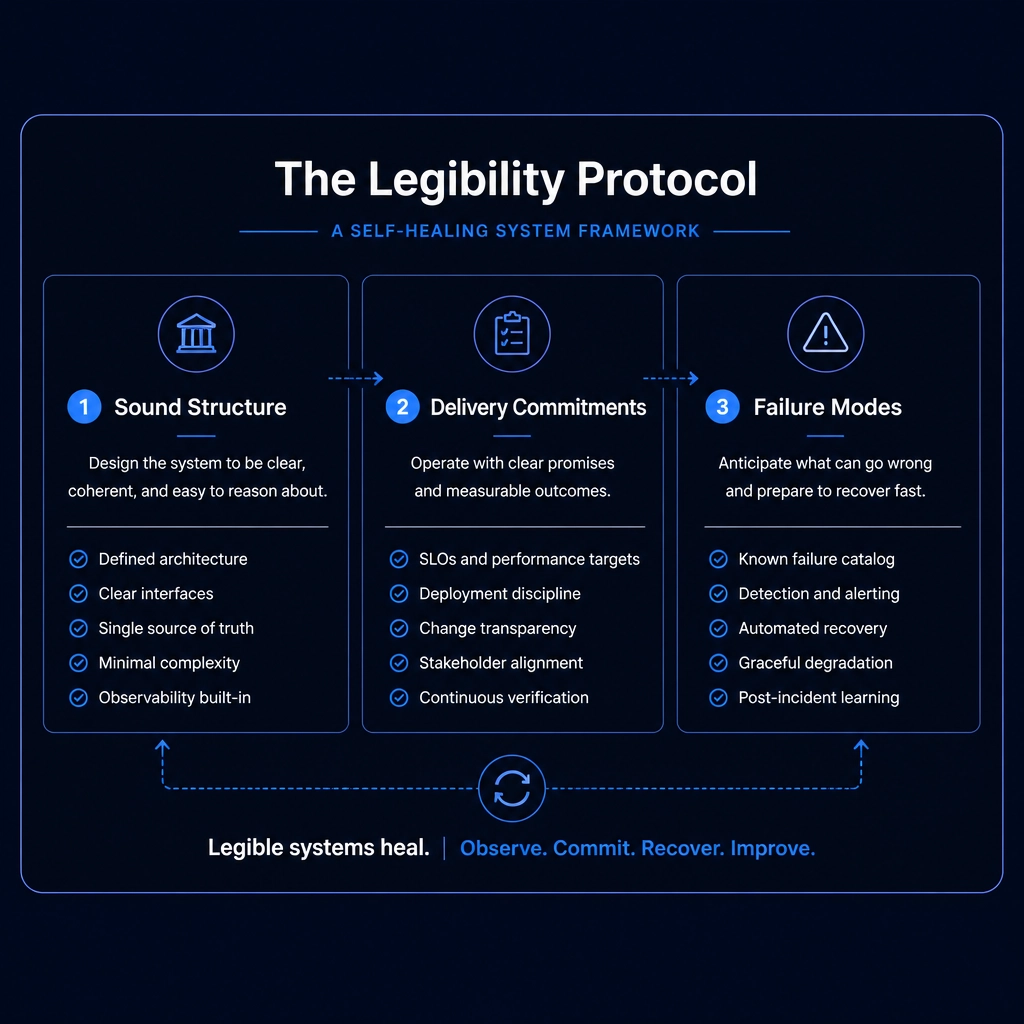
People hear governance and think compliance. Policies, approvals, another layer of slow. That is not what I mean. Governance done right is not about control. It is about coherence. It routes ownership, forces clarity, closes a loop with proof instead of a promise. It is minimalist. It does not add meetings, it removes the ones you were holding to cover for a decision nobody actually made. When it is real, problems show up as signals instead of surprises.
I built all of this before I needed it. On purpose. Governance cannot be retrofitted without pain. I have watched people bolt it on after the fracture, and it is always uglier and more expensive than building it in would have been. Most founders wait until things break to build the system. I didn't. Integrity scales better than memory, and it scales best when you design it early, while the company is still small enough that the discipline costs you almost nothing.
The morning the light came on in an empty car
That is the version of this I have been telling for a while. It is true. It is also not finished, and this morning is why.
This morning I sat down to check whether my company had done its work overnight.
That should sound strange. I built the thing so I would not have to check. Overnight, while I sleep, the company runs a set of jobs on its own. It closes the day, sorts what came in, moves the work forward, squares the numbers. I am not in the loop for any of it, on purpose. I am supposed to wake up to a company that already handled its own morning.
So I sat down, out of habit, and two of those jobs had quietly failed. Not crashed. No error. They ran, did nothing, and left a clean gap where the work should have been. The only thing in the entire company that noticed was me, sitting there with my coffee, looking.
That stopped me. Not the two jobs, those I could fix in ten minutes. The problem was that my attention was the detection system. For all my talk about a company that surfaces its own problems, it had quietly gone back to leaning on the one thing I swore I would design around. Me, noticing. And I only noticed because I happened to look.
What I had actually built was narrower than the story I told about it. The check engine light works right up until nobody is looking at the dash. This morning the light came on in an empty car. The company could raise its hand. It still needed me to see the hand go up.
The piece that earns the word
So I built the last piece, and it is the piece that earns the word. Surfacing a problem is instruments. Healing is a different thing. The company now checks, every morning, that the work it was supposed to do actually got done, and when something quietly did nothing, it knows. When a job fails in a way that just needs running again, it runs it again, before I am awake, and I never hear about it. I do not need to know about every hiccup. I need the hiccups handled.
And when the same thing keeps breaking and a retry is only a band-aid, it does not hand me the problem. It hands me the fix. It works out what is wrong, drafts the change, here is the rule now and here is what it should say instead, and puts that in front of me. I say yes, or I say no and do something else.
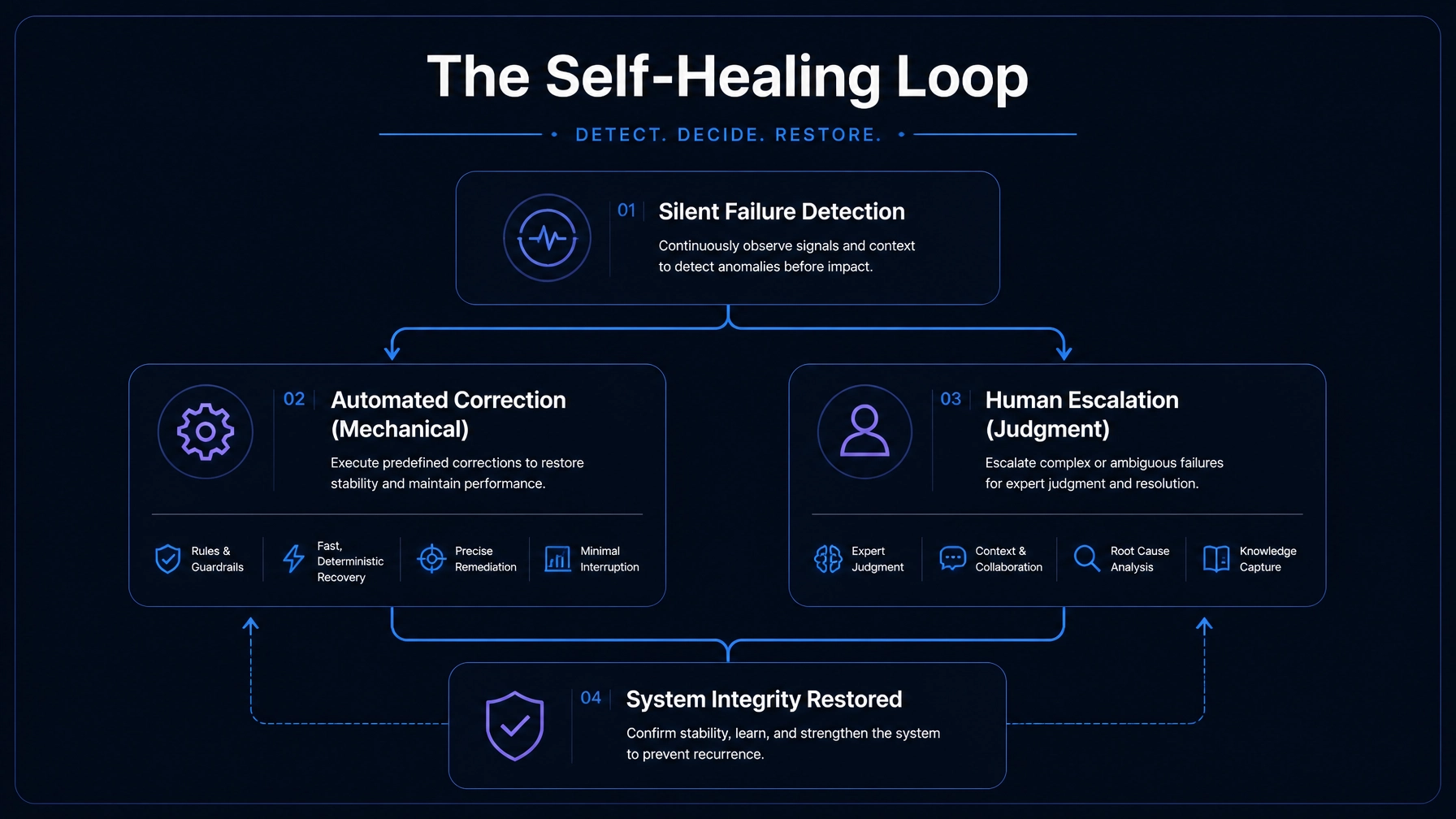
That last part is the line I do not cross. The human stays on the trigger. Nothing irreversible happens without me. The company heals what is mechanical and transient on its own, and it brings me the judgment calls, and it never confuses the two. The moment a system starts making the irreversible decisions by itself, you have not built a self-healing company. You have built a fast way to make a bad call at scale. That is process theater with better tooling.
Work is cheap now. Judgment is not.
I used to think the point of all this was efficiency. More done, faster, with less. I do not think that anymore. Work was never the scarce thing. Work is cheap now. You can hand almost any task to a machine and it will grind it out forever. What stays scarce is judgment. Knowing when the work is wrong. And for years the only judgment in my company that could catch a silent failure was mine. Speeding up the work does nothing about that. It just makes more output for one set of eyes to check.
The thing that failed in my company at six in the morning is the same thing that broke me in those scaling orgs. A company that quietly leans on one person's attention to hold itself together, until the morning that attention is somewhere else. I left those companies so I would not have to be that person. Turns out I had to build my way out of being that person here too.
Most people in my line of work will hand you a framework for this. A model, a slide, a diagram of how a healthy company is supposed to run. I run one. When it breaks, it tells me. Now it fixes what it can, and it brings me the rest with the repair already written. The company I would show you is the company I am describing. There is no gap between what I say and what I run.
If you run a company, you already know the feeling underneath all of this, even without a name for it. The meeting that exists to cover for a decision nobody made. The same issue back for the third time. Your best people spending more of the week managing confusion than building anything. That is not a talent problem and it is not a culture problem. It is the architecture underneath, and once you see it you cannot unsee it. The self-healing company is what you build on the other side of seeing it. One that catches its own drift, surfaces its own risk, and keeps the judgment where it belongs, with a person. You do not need my stack to build it. You need to decide, early, that your company should be able to explain itself without you in the room.
This is not a state you reach. It is a way you operate. That is the company I wanted from the day I got laid off. Not one that never breaks. One that does not need me to be the thing holding it together, only the one deciding what happens next.
Key takeaways
Most execution problems are decision problems: unclear decision rights, implicit tradeoffs, and unowned commitments that accumulate as decision debt.
The real constraint on scaling is usually architecture, not talent. Adding headcount or frameworks to a company with weak decision architecture raises coordination cost without fixing the underlying structure.
A self-healing company separates three concerns that most organizations blur together: whether the structure is sound, what the organization is committing to deliver, and what could fail. Keeping them distinct lets problems surface as signals instead of crises.
Governance in this model is about coherence rather than control. Its job is to route ownership, force clarity, and close decision loops with proof, not to add approvals or meetings.
Building governance early is cheaper than retrofitted it. Integrity scales better than memory when the discipline is designed in while the company is still small.
Automation should surface and correct mechanical failures but escalate judgment calls to a human. A system that makes irreversible decisions on its own trades safety for speed.
Frequently asked questions about the self-healing company
What is a self-healing company?
A self-healing company is an organization designed to detect its own problems, correct the ones that are mechanical or transient, and escalate the rest to a human for a decision. It does not depend on one person noticing that something has gone wrong. The goal is not a company that never breaks, but one that catches its own drift early and keeps a human in control of any consequential decision.
How is a self-healing company different from an efficient one?
Efficiency optimizes for producing more output with less effort. A self-healing company optimizes for catching its own mistakes and preserving judgment as it scales. The two are not the same: speeding up work does nothing to detect a silent failure, and can make the problem worse by generating more output for one person to check. The scarce resource being protected is judgment, not speed.
What is decision architecture?
Decision architecture is the underlying structure that determines who owns which decisions, how tradeoffs are surfaced, where commitments are made, and whether those commitments hold across time and teams. It is distinct from process or frameworks; it is the layer beneath them that decides whether any process actually works. A self-healing company is decision architecture that has begun to run on its own.
What is decision debt?
Decision debt is the accumulation of unresolved calls, deferred tradeoffs, and ambiguous ownership inside an organization. It builds up quietly until nearly every conversation becomes a negotiation and the same issues resurface repeatedly. Leaders often misread decision debt as an execution or talent problem and respond by hiring or adding process, which does not address the structural cause.
Why build governance before a company needs it?
Governance cannot be retrofitted without significant cost and disruption, because bolting it on after a structural failure is more expensive and disruptive than designing it in early. When a company is still small, the discipline of logging decisions and separating concerns costs almost nothing. Integrity scales better than memory, and it scales best when the structure is built before growth exposes the gaps.
Does a self-healing company remove humans from decisions?
No. In this model, automation handles what is mechanical and transient, such as retrying a failed routine, but any irreversible or consequential decision is escalated to a human. A system that makes irreversible decisions on its own is not self-healing; it is a faster way to make a bad decision at scale. The human stays on the trigger by design.
Does building a self-healing company require a specific software stack?
No. The self-healing company is an operating principle, not a particular set of tools. It requires deciding early that the company should be able to explain itself without any single person in the room, and then building the structure that detects drift, surfaces risk, and preserves judgment. The specific tools used to implement it are a secondary choice.
I help product leaders at complex product organizations unblock execution when their decision architecture starts breaking down, so that they can ship the roadmap they committed to without another quarter of explanation.
If this sounds familiar, you're not alone.
The work is not about moving faster. It is about preserving judgment as systems scale.
If you are navigating this right now, book a Relevance Check™. We will walk through what you can move first.
No pitch. Just the read.
Clinton Pracher | CP Product Advisory