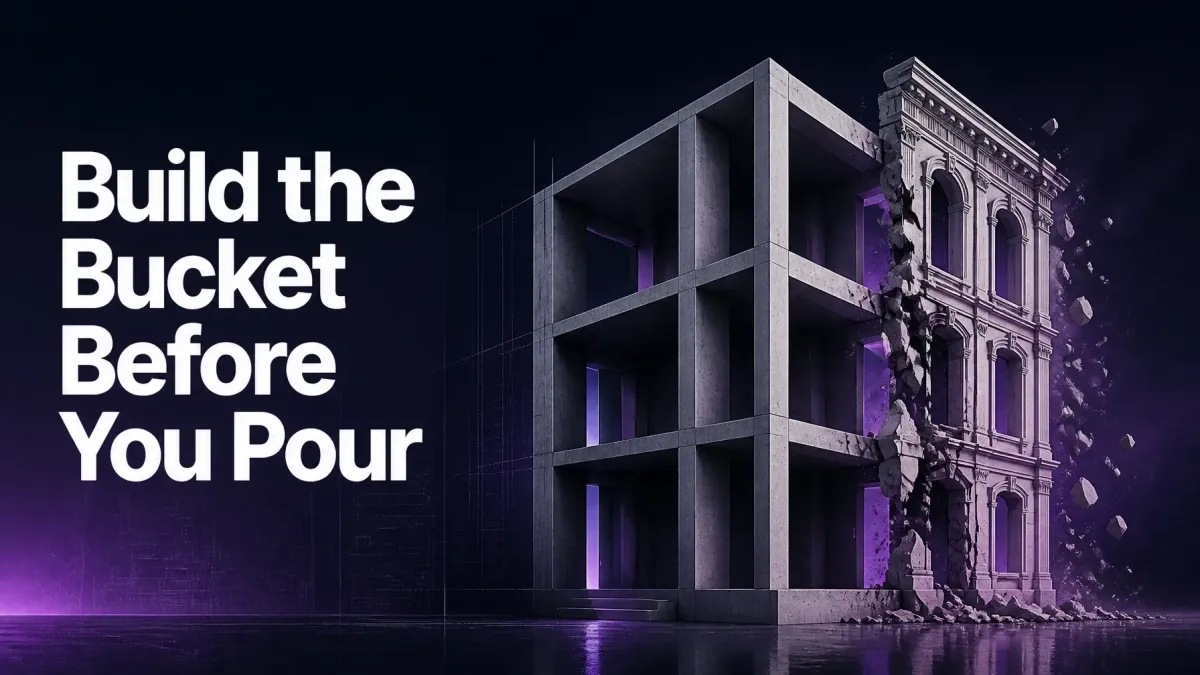
Build the Bucket Before You Pour
The work that holds the weight is the work nobody claps for.
TL;DR
Under constraint, the instinct is to do the visible work, because it photographs well and looks like progress. The operators who win do the load-bearing work first, the thing everything else rests on, even when it looks like nothing is happening. Load-bearing work is invisible right up until its absence becomes a crisis, and the crisis always costs more than the deferral saved. The test is simple: ask what depends on this, and what happens if it's missing or wrong. If a lot fails, it's load-bearing and it goes first. The hard part isn't knowing that. It's having the nerve to look unproductive while you build the bottom of the bucket.
Last week I had a finished essay sitting in a folder, ready to publish. I did not publish it.
Instead I spent the day building a subscribe form, wiring it to a backend, and fixing the way it rendered on a phone. Nobody saw any of it. From the outside, I produced nothing that day. No post went up. No content shipped. If you had asked what I accomplished, the honest answer was "plumbing."
Here is why I made that call. Publishing the essay first would have been writing into a bucket with no bottom. The readers it brought in would have shown up, found no way to subscribe, and left, and I would have paid to acquire an audience I had no way to keep. The content was the visible work. The funnel was the load-bearing work. And the load-bearing work goes first, even when it looks like nothing is happening.
That is the whole discipline, and almost nobody has it. Not because they do not understand it. Because the visible work feels like progress, and the load-bearing work feels like a delay.

The Tax on Looking Busy
The pull toward visible work is not a character flaw. It is a response to real pressure. When you are under constraint, time, money, runway, attention, you feel like you owe everyone proof that you are moving. Visible work is proof. It is the thing you can point to in a standup, drop in a Slack channel, put on a slide. It photographs well.
Load-bearing work does not. The platform refactor that makes the next ten features possible looks identical, from the outside, to doing nothing. The decision framework that will stop next quarter's thrash produces no demo. The funnel I built produced no post. So the incentive is brutal and constant. Do the work that looks like work, and defer the work that actually holds the thing up, because the first one buys you approval today and the second one only pays off later, quietly, in a problem that never happens.
You can watch whole companies run on this tax. The team that ships feature after feature on a foundation that cannot hold them, because shipping is legible to leadership and fixing the foundation is not. The founder who keeps doing sales calls instead of building the system that would let someone else do sales calls, because the calls feel productive and the system feels like procrastination. The org that runs another alignment offsite instead of fixing the decision rights underneath the misalignment, because the offsite is a visible act and the rights are invisible plumbing.
Every one of those is the same mistake. Choosing the work that looks like progress over the work that creates it.
What Load-Bearing Actually Means
Load-bearing is a word worth keeping literal. In a building, a load-bearing wall is the one holding the weight above it. Knock down a decorative wall and the house stands. Knock down a load-bearing one and the floor above comes with it. The two can look identical from the hallway. The difference only shows up under load.
Work is the same. Load-bearing work is the work everything else rests on. If it is missing or weak, the work you stack on top of it does not just underperform, it collapses, or it leaks away. The funnel was load-bearing for the content, because without it the content had nowhere to land. The data architecture is load-bearing for the dashboard. The decision rights are load-bearing for the roadmap. The onboarding flow is load-bearing for every dollar of acquisition spend behind it.
Here is the test. Ask what depends on this, and what happens to those things if this is missing or wrong. If the answer is "a lot, and they fail," it is load-bearing, and it goes first. If the answer is "not much, it just is not done yet," it is visible work, and it can wait. The trap is that visible work almost always feels more urgent, because its absence is obvious and a little embarrassing, while the absence of load-bearing work stays invisible right up until the moment it is catastrophic.
Most prioritization fights are actually this confusion. Two things feel urgent. One is load-bearing and one is visible, and the team argues about which is more important without noticing they are not even the same kind of thing. Importance is the wrong axis. The question is what holds weight, and what is just standing in front of it.

This Is a Product Problem Wearing a Content Costume
I told the funnel story because it is small and clean, but the reason it matters is that it is the same mistake I get hired to fix, just at a scale where it costs millions instead of a weekend.
A product org ships features onto a platform that was never rearchitected to hold them. Each one works in the demo. Then the load shows up, the thing that was supposed to scale starts buckling, and now you are not adding features, you are firefighting the foundation you skipped. The features were visible. The platform was load-bearing. Somebody chose the demo.
A leadership team writes a roadmap before it has decided who owns which trade-offs. The roadmap looks like a plan. Then the first real conflict hits, the call gets overridden, and the roadmap quietly stops meaning anything, because the decision architecture underneath it was never built. The roadmap was visible. The decision rights were load-bearing. Somebody chose the slide.
A company scales headcount before it scales its operating model. Hiring is visible, legible, celebrated. The operating model is invisible plumbing. So they add people to a system that cannot coordinate them, capacity goes up while output stays flat, and nobody can say why. The hires were visible. The operating model was load-bearing.
It is the same shape every time. The visible thing gets built first because it is what leadership can see and reward, and the load-bearing thing gets deferred because its value is invisible until its absence becomes a crisis. The crisis is always more expensive than the deferral saved. Always. That is the entire trade you make when you choose visible over load-bearing, whether the stakes are a Substack funnel or a platform serving a hundred markets.
The discipline scales. So does the cost of not having it.

The Part That Costs You Something
Knowing what is load-bearing is the easy half. Doing it first is the hard half, because doing it first means choosing, on purpose, to look unproductive for a while.
That is the real tax, and it is not abstract. When you do the load-bearing work first, you go quiet. No post ships. No feature demos. No new logo on the slide. Meanwhile someone next to you is shipping visible work and getting credit for it, and you are building a thing nobody can see yet, on the conviction that it will matter more later. If you cannot stomach that gap, the discomfort of producing nothing legible while someone else collects the applause, you will quietly drift back to visible work, because visible work pays you in approval today. Most people drift. That is the whole reason load-bearing work is a competitive advantage. It is not hard to understand. It is hard to tolerate.
There is one move that makes it survivable, and it is not willpower. It is making the load-bearing work legible. The reason it feels like doing nothing is that nobody named it as the work. So name it. Do not disappear into the plumbing and hope people are patient. Say the quiet part out loud. "I am not shipping content this week. I am building the funnel, because content without it leaks. Content starts next week." Now the invisible work has a shape. It is a decision with a reason and a sequence, not a gap in your output.
This is what separates an operator from someone just avoiding the hard visible work. An operator can tell you exactly why the boring thing comes first, what depends on it, and when the visible work resumes. The sequence is deliberate and they can defend it. Avoidance looks similar from the outside and is the opposite underneath: no test, no sequence, just a preference for the comfortable task dressed up as strategy. The difference is whether you can name the load and point to what it holds.

Build the Bucket Before You Pour
Everything you produce, every post, every feature, every hire, every dollar of spend, gets poured into something. The only question that matters is whether the something has a bottom.
You can pour faster. You can pour more. None of it counts if it runs straight through. The work that builds the bottom of the bucket is almost always the work nobody claps for, the work that looks like a delay, the work that produces nothing you can show on Friday. That is exactly why it is the work that wins, because almost everyone skips it for something that photographs better.
So before you pour, build the bucket. Find the thing everything else depends on, do it first, and have the nerve to look unproductive while you do. The applause is on the other side, and it lasts longer.
Frequently asked questions about prioritizing load-bearing work
How should work be sequenced under constraint?
A reliable approach is to complete the load-bearing work first, meaning the work that everything else depends on, even when it produces nothing visible. Each option can be evaluated by asking what depends on it and what fails if it is missing or wrong. Work that many things depend on should take priority over work that is merely more visible.
What is load-bearing work?
Load-bearing work is the work that other work rests on. As with a load-bearing wall, if it is missing or weak, the work built on top of it collapses or loses value rather than simply underperforming. Examples include a subscribe funnel for content, data architecture for a dashboard, and decision rights for a roadmap. Its importance is often apparent only under load.
Why do teams default to visible work?
Under pressure, teams tend to favor work that demonstrates progress, because visible output is easy to report and is rewarded sooner. Load-bearing work usually produces no immediate demonstration and can resemble inactivity, so it is deferred even though its absence is the more expensive problem. The incentive structure favors visible activity over foundational work.
What distinguishes prioritizing load-bearing work from avoiding harder visible work?
The difference is whether the sequence is deliberate and defensible. Prioritizing load-bearing work comes with a clear account of what depends on it and when visible work resumes. Avoidance lacks that test and sequence and is better described as a preference for the easier task. The distinguishing factor is whether the dependency can be named.
How can foundational work be sustained when it is not visible?
A practical method is to make the work legible by naming it explicitly: what it is, why it comes first, and when visible output resumes. Stating this converts an apparent gap in output into a documented decision with a reason and a sequence. This communication, rather than willpower, is what makes a period of low visible output sustainable.
I help product leaders at complex product organizations unblock execution when their decision architecture starts breaking down, so that they can ship the roadmap they committed to without another quarter of explanation.
If this sounds familiar, you're not alone.
The work is not about moving faster. It is about preserving judgment as systems scale.
If you are navigating this right now, book a Relevance Check™.
No pitch. Just the read.
Clinton Pracher | CP Product Advisory