
Agents Don't Replace Your Team. They Expose Your Judgment.
Everyone is selling AI agents as a team you can buy. I run my practice on them, and the hard part was never the agents. It was deciding what I refuse to hand them.
TL;DR
Everyone is selling AI agents as a team you can buy. I run my whole practice on them, and the agents were the easy part. They compress execution, the cheap work that was never the bottleneck, while the expensive work, judgment, stays exactly where it was. Agents don’t fail like people. They do the wrong thing fast, in clean formatting, with no hesitation to warn you, so capacity without judgment isn’t leverage, it’s faster wrongness. The fix is a governance layer that decides what an agent does on its own, what it has to bring you first, and what it never touches. That isn’t an AI problem. It’s the old scaling problem, capacity outrunning judgment, running at 10x speed.
The pitch is everywhere now. One person, a stack of AI agents, a seven-figure business with no employees. Fortune ran it in May. Solo-founded companies are now about a third of all new ventures. The surveys promise 340 percent revenue jumps for the price of a few subscriptions. The whole thing gets sold as leverage. Replace the team, keep the output, work less.
I actually run my company this way. An executive assistant, a set of content agents, and a chief-of-staff layer sitting above all of them, doing real work every day.
So let me tell you the part nobody is selling.
The agents were the easy part. Standing them up took a weekend. The hard part, the part that decides whether this works or quietly wrecks your business, is judgment. A swarm of agents with nobody governing them does not give you a company. It gives you a very fast, very confident way to do the wrong thing at scale. The hype sells you leverage. What it hands you is a system that will execute a bad call flawlessly and never once tell you it was bad.
What Actually Got Easier
Let me be fair to the dream before I take it apart. The leverage is real. That part is not a lie.
A year ago, the work that ate my week was not the thinking. It was the execution around the thinking. Cleaning my inbox. Drafting the first version of a post. Triaging which of forty job and client emails actually needed me. Formatting. Filing. The administrative tax that sits between having a thought and doing something with it. All of that genuinely compressed. My executive assistant runs the inbox. The content agents turn a rough idea into a draft I can react to instead of a blank page I have to fill. The chief-of-staff layer keeps the whole thing moving without me holding every thread in my head.
That is not nothing. It is the difference between running a practice solo and drowning in one. I get more done in a day than I used to get done in a week, and most of it I never touch until the part that actually needs me.
So yes. The output went up. The hours went down. The brochure is accurate.
But look closely at what got easier. It was execution. Every bit of it. The drafting, the triaging, the formatting, the filing, the moving things along. The agents took the cheap work and made it cheaper, which is what they are good at and what you should hand them.
What did not get easier was deciding. Which post is worth writing. Which client is worth taking. Whether the draft is actually right or just smooth. What an email really means and what saying yes to it commits me to. None of that moved an inch, because none of it was ever the bottleneck. The bottleneck was never typing speed. It was judgment, and judgment is the one thing the agents cannot do for you, no matter how many you stand up.
Confident, Not Right
Here is the thing the dream never mentions. Agents do not fail like people fail.
When you hand work to a junior employee, their inexperience shows up as friction. They hesitate. They ask a clarifying question. They flag the part they were not sure about. They send you a draft with a note that says “I wasn’t confident about the third section.” That friction is annoying, and it is also a safety system. It tells you where to look.
An agent has no friction. It does the wrong thing at full speed, in clean formatting, with a confident summary of what it accomplished. It does not hedge. It does not flag the part it guessed at. It hands you something that looks finished, reads well, and is quietly wrong in a way you will not catch unless you already know what right looks like.
I have watched one of my content agents take a piece of locked copy, a line that is not allowed to change, and rewrite it into something smoother and completely against the rule. Twice. Beautiful prose. Wrong on the one thing that mattered. If I had not known the rule cold, it would have shipped, and it would have looked great doing it.
That is the actual risk, and it is the opposite of the one people worry about. Nobody gets hurt because the agent is dumb. You get hurt because the agent is plausible. It produces work that clears the bar for “looks done” while missing the bar for “is right,” and those two bars sit very far apart on anything that involves judgment.
A bad hire is slow and obvious. A bad agent is fast and convincing. Scale that across an inbox, a content pipeline, and a dozen daily calls, and you do not have a team that occasionally errs. You have a machine that manufactures confident mistakes faster than you can read them, and hands each one to you wearing a clean shirt.
The leverage cuts both ways. Agents do not just execute your good calls faster. They execute your bad ones faster too, and they never once look up.
The Judgment Line
Once you accept that agents execute everything at the same confident speed, good calls and bad ones alike, the whole game becomes one question. What are you willing to let them decide, and what stays with you.
Most people draw that line by capability. They delegate whatever the agent is good enough to handle and keep whatever it cannot do yet. That is the wrong axis, and it is where people get hurt, because agents are good enough to do almost anything that looks like work. Capability is not the constraint. Consequence is.
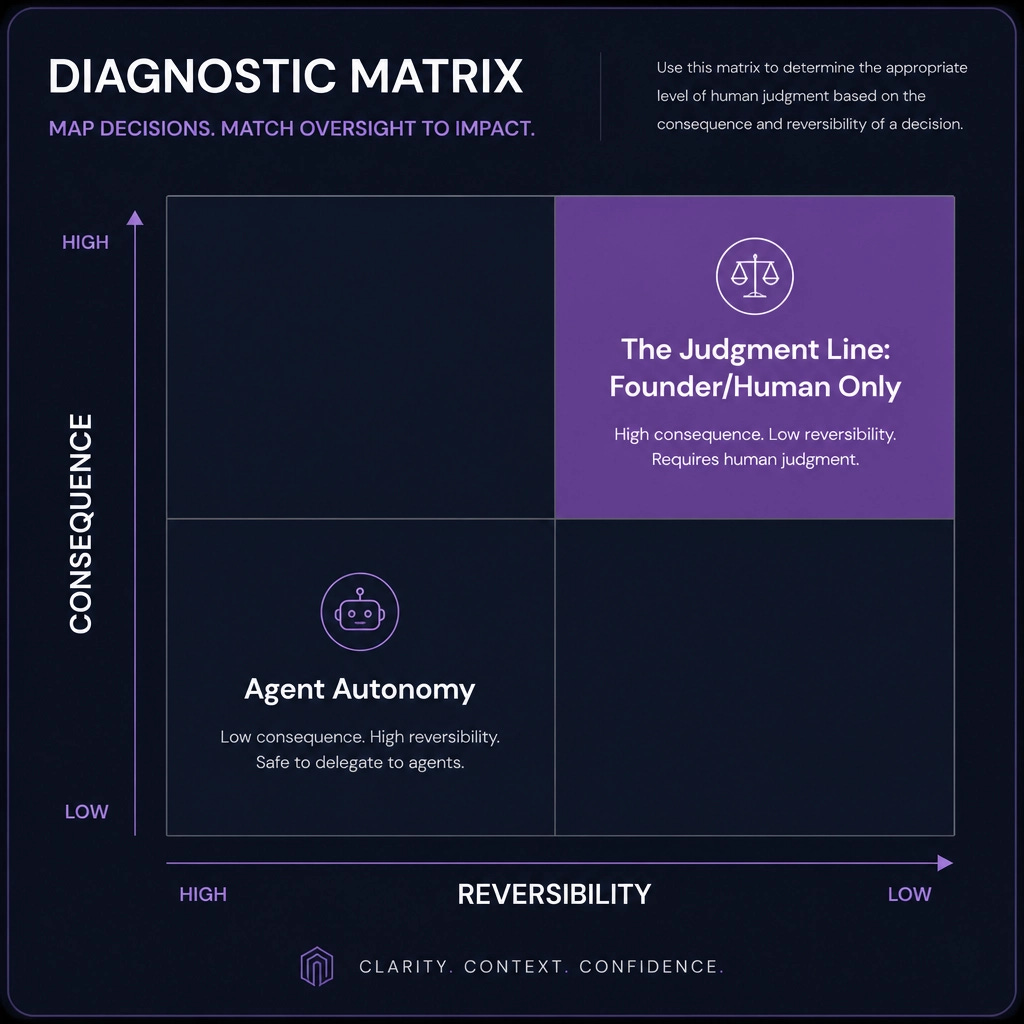
I draw the line by consequence and reversibility, not by skill. If a task is reversible and low-stakes, the agent owns it, even if it gets it wrong sometimes, because the cost of a miss is a thirty-second fix. Filing an email to the wrong label. A clunky first draft. A triage call I can override in one click. Hand all of it over. The whole point of handing it off is to stop spending yourself on work where being wrong costs nothing.
But anything that encodes a value, carries a relationship, commits me to a direction, or is hard to undo stays mine. What I publish under my name. Which client I take and which I turn down. What a decision actually means and what saying yes to it locks me into. The price I charge. The line I will not cross to hit a number. None of that is delegable, not because the agent cannot generate an answer, but because the answer is the thing I am actually selling. The moment I let an agent make those calls, I am not running a leveraged practice. I am running a generated one, and people can feel the difference even when they cannot name it.
So the division of labor is simple to say and hard to hold. Agents draft, I decide. Agents triage, I set the rules they triage by. Agents produce the volume, I own what ships and what it means. They handle the part that scales. I keep the part that does not, because the part that does not scale is the entire reason anyone hires me instead of a prompt.
That line is the job now. Not the typing. The deciding what never gets typed by anything but me.
So I Built Them a Boss

When my setup started getting real, the obvious move was the one everyone makes. Add more agents. Something is slow, stand up an agent for it. Something falls through, stand up an agent to catch it. For a while the answer to every gap was another worker.
It made things faster and less stable at the same time. More agents meant more confident output, more plausible mistakes, more places where something could go wrong quietly. I had more speed and less control, which is the exact trade the dream swears you do not have to make.
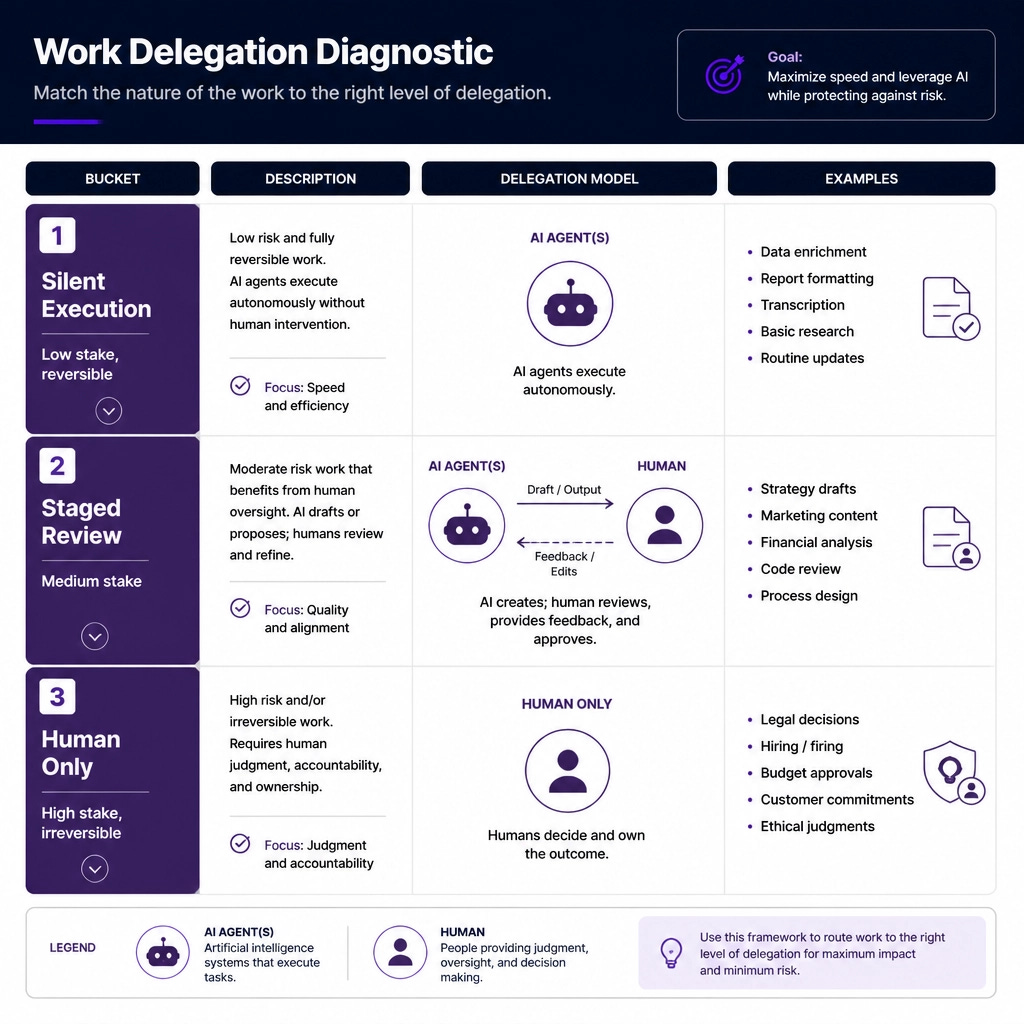
What fixed it was not another worker. It was a manager. I built a layer that sits above all the other agents and does nothing but judgment. A chief of staff. Its entire job is to decide what the other agents are allowed to do on their own, what they have to bring to me first, and what they are never permitted to touch.
That last part is the whole thing. Every move an agent could make falls into one of three buckets. There is the work it just does, silently, because it is reversible and low stakes, and surfacing it would only waste my attention. There is the work it has to stage and show me before it goes anywhere, because it touches something with consequence. And there is the work it does not get to do at all, the calls that are mine by definition, where the agent brings me the context and then stops.
Drawing those buckets is not a technical problem. It is a judgment problem, and it is the actual work of running on agents. The hype acts like the hard part is wiring the tools together. The hard part is deciding, for every kind of move, how much autonomy it gets, and then building something that holds that line even when I am not watching. Without that layer, you do not have a team. You have a dozen confident interns with no manager and root access to your business.
More agents give you speed. The governance layer is what turns the speed into something you can trust. Almost nobody building these stacks is doing the second part, which is exactly why so many of them produce a lot of motion and a quiet mess underneath.
This Was Never About AI
Everything I just described, the confident execution outrunning the judgment, the speed that quietly turns into a mess, the need for a layer that decides what gets to happen without a human in the loop, none of it is an AI problem. It is a scaling problem. Agents did not invent it. They just ran it fast enough that I could not look away.
I have seen the same failure in every growing company I have worked with, only slower and harder to spot. A company adds people faster than it adds judgment. Headcount goes up, output goes up, and somewhere in there the number of decisions being made by people without the full context goes up too. For a while it looks like growth. Then the confident mistakes start compounding, the same way they do with agents, except it takes quarters instead of minutes to see them. By the time it is obvious, nobody can point to the decision that started it, because there was no decision. There was just a lot of capable people executing in a system that never settled who held the judgment.
That is what the agent stack taught me at 10x speed. Capacity without judgment is not leverage. It is just faster wrongness. The industry is starting to admit a version of this from the inside. The smart read on agentic work is that the job stops being about output and becomes orchestration and governance, managing the fleet instead of doing the work. That is correct, and it is not new. It is what running anything at scale has always required. The agents just made it impossible to pretend otherwise.
A swarm of agents with no governance is a startup that hired fifty people and never decided who gets to say no. The technology is new. The failure is ancient. And the fix is the same in both cases. You build the decision architecture before the capacity outruns it, not after.
What the Flex Actually Is
So when someone asks whether I run my business on AI agents, the honest answer is yes, and it is also the least interesting thing about it.
The flex was never the automation. Anyone can stand up a stack of agents now. That is a weekend and a credit card. The flex is that after all of it, the speed, the volume, the output, the judgment stayed mine. Nothing ships under my name that I did not decide. No client gets taken, no price gets set, no line gets crossed by a machine optimizing for done. The agents made me faster everywhere it was safe to be faster, and nowhere it was not.
You can feel the difference in the output, even when you cannot name it. Work that came out of a real decision reads like a person stood behind it. Work that came out of an ungoverned agent reads smooth and hollow, technically fine and somehow nobody home. The market is getting very good, very fast, at telling those two apart. The companies that win the next few years will not be the ones with the most agents. They will be the ones that scaled their capacity without ever letting go of their judgment.
That is the whole job now. Not doing more. Deciding what only you can decide, and building everything else to serve it.
Frequently asked questions about running a business on AI agents
Can a business run on AI agents?
Yes. Operators commonly combine assistant, content, and coordination agents to increase output and reduce hours. The gains concentrate in execution, such as drafting, triage, formatting, and filing. Decision-making does not scale the same way, because it is typically the constraint rather than execution speed.
What is the hardest part of running on AI agents?
The difficult part is judgment and the governance that protects it, not standing up the agents. The core work is deciding what agents may do autonomously and what must stay with a person, then building controls that hold when no one is reviewing. Without governance, a set of agents produces fast, confident output with no assurance that it is correct.
How do AI agents fail differently from human employees?
A junior employee tends to signal uncertainty by hesitating, asking questions, or flagging weak sections, which tells a reviewer where to look. An agent produces complete, confidently formatted output regardless of correctness and rarely indicates what it inferred. The practical risk is that agent errors are faster and more plausible, which makes them easier to miss.
What should be delegated to an AI agent, and what should be retained?
A useful rule is to delegate by consequence and reversibility rather than by capability. Reversible, low-stakes tasks are good candidates because the cost of an error is small. Decisions that encode values, carry relationships, set direction, or are hard to reverse are better retained, because that judgment is usually the core of the offering.
What is an AI agent governance layer?
A governance layer is a controlling function that sits above individual agents and manages judgment rather than performing tasks. It defines what each agent may do automatically, what must be staged for human review, and what is off-limits. Designing those boundaries is primarily a judgment and policy problem rather than a technical one.
Do AI agents replace a team?
No. They increase the consequence of the operator's judgment, because they execute strong and weak decisions at the same speed. Capacity without governance produces faster errors rather than leverage. The organizations that benefit most are those that scale capacity while keeping clear ownership of judgment.
I help product leaders at complex product organizations unblock execution when their decision architecture starts breaking down, so that they can ship the roadmap they committed to without another quarter of explanation.
If this sounds familiar, you’re not alone.
The work is not about moving faster. It is about preserving judgment as systems scale.
If you are navigating this right now, book a Relevance Check™.
No pitch. Just the read.
Clinton Pracher | CP Product Advisory