Agent Control Plane Observability: What I Look at Before I Trust the Morning
Green tiles lie. A control plane should tell you what ran, what failed, and what to do next.
TL;DR
Agent Control Plane observability is a daily read surface that proves scheduled AI work ran using durable ledger records, not chat transcripts. It answers three questions every morning: did the work run, is the fleet healthy, and what blocks green. Five contracts map trust into pass-or-fail signals with named cause, fix, route, and done-when conditions. Proof coverage separates the morning desk SLO from the full automation registry so weekday gaps are not misread as failure. The design optimizes for Wednesday morning trust over Tuesday demo sparkle.
Three windows, and still no proof
I had three AI windows open on a Tuesday, and every one of them sounded confident.
One still owned a brief I had already moved. One was running an audit I thought I had turned off. One had a schedule I could not swear was canonical. Nothing exploded. No red banner. Just that low-grade nausea you get when the tools are busy and you cannot name what is true.
I'm like, this is not a model problem. This is a proof problem.
That was the scene that pushed me toward observability. Not because the models were wrong. Because I had no single place that could tell me, with evidence, what had actually run overnight and what was still safe to trust before I locked the brief.
I had already written the ownership essay. Active Writer rules. Durable identity. Audit that does not quietly heal. That layer answered who may write. It did not answer what had been written last night in a form I could verify at 7:20 AM with the brief still open.
So I kept doing what operators do when the architecture is half-built. I sampled. I checked a chat. I checked a tile. I checked my memory of which schedule I thought I had disabled. Sampling is not proof. It is triangulation with fatigue.
The morning a stale surface almost cleared the brief
Wednesday, 26 August. I opened the control plane page expecting to lock the morning brief.
Run evidence looked fine. Fleet health looked fine. Trust read Trusted. Most of the page wanted to tell me I was done.
Hub freshness did not.
The cleanup report was stale. The overnight jobs had left proof rows. The hygiene work had run. The surface the brief still linked to had not been rebuilt. That is the failure mode I keep calling stale surface: the ledger says healthy while a page you still treat as canonical is older than its freshness window.
I'm not sure how long I would have caught that by feel. The chats from overnight sounded clean. One had summarized the hygiene pass like it was done. The summary tiles were green enough to let me move on. I was one click away from locking a brief that would have pointed at yesterday's report and called it current.
If I had locked, the failure would not have shown up as a crash. It would have shown up as confidence. I would have walked into the day carrying a brief that looked authoritative and was partially wrong. That is worse than a red banner. A red banner at least forces a decision.
The page named the mismatch in plain language: refresh the stale report, rerun the sync, confirm the hub before lock. No script path. No repo jargon. Just the operational next step.
That was the decision point. I stopped treating chat confidence as morning proof. I rebuilt the hygiene snapshot, reran the sync, and only then did the banner read All green. No blocking work before the brief.
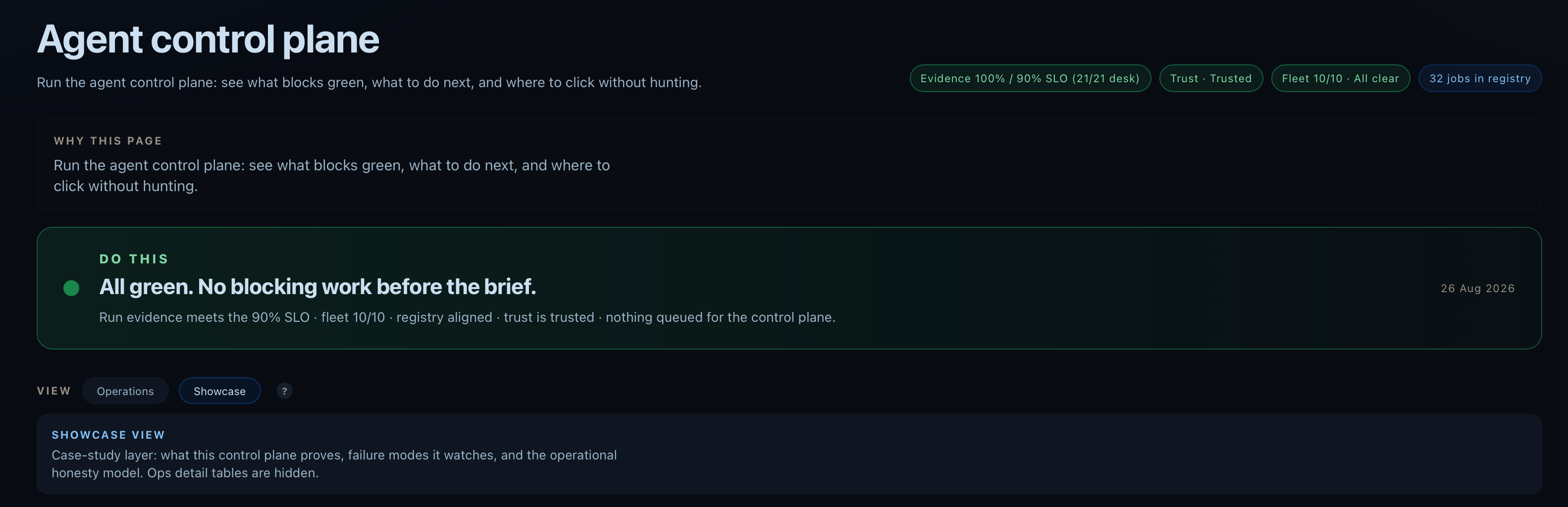
The dashboard did not save me from work. It saved me from locking a brief on a surface I would have sworn was current.
Green tiles and chat logs
The usual fix for this kind of anxiety is more visibility.
Add a dashboard. Add a health check. Add a summary email that sounds authoritative. If the tile is green, assume you are fine. If the model said it ran, assume it ran.
I have watched that pattern fail quietly, including on mornings when I was the only operator in the room and nobody else would have caught the drift.
Silent omission: no run record, but the morning still looks clean. False green: stub evidence treated as completion. Split brain: the schedule in the UI, the task registry, and the manifest disagree. Proof gap: a run marked complete with nothing attached you can audit tomorrow.
None of those fail with sirens. They fail as two morning briefs, a stale tracker, and a helpful re-run that overwrites the fix you made by hand. Then the stack becomes another Shadow Roadmap: visible motion that does not hold the outcome up.
I have seen teams recover from loud failures faster than from quiet ones. A loud failure forces a meeting. A quiet one lets you keep shipping on a version of the truth nobody fully owns. That is why I stopped treating "looks fine" as an operator input. Fine is a claim. Proof is the receipt.
Chat logs are noise with timestamps. Proof is a durable record you can reopen on Thursday and still defend.
I used to think the problem was finding a smarter model. The stale-surface morning convinced me the problem was finding a dumber lie early, before judgment gets spent on the wrong lock.
What the page is actually for
Observability sits on top of ownership, not instead of it.
The ownership layer decides who may write. Without that, you are auditing chaos. With it, the observability layer can ask three questions every morning and expect honest answers:
Did the work run? Is the fleet healthy? What blocks green?
Everything on the page exists to make those answers legible before judgment gets diluted across surfaces. I built it after the stale-surface morning because I needed one read surface that could disagree with chat confidence without making me hunt for the disagreement.
The screenshots in this essay are from the pass after that disagreement got cleared. They are not a tour of every tab. They are the evidence that the morning eventually became safe to lock.
Trust decomposed into five contracts
After the stale-surface morning, I stopped wanting a single "Trusted" pill. One word is too easy to perform.

I split trust into five contracts because each one catches a different kind of lie:
Authority: Schedule drift between registry and live automations
Proof: Overnight jobs that did not leave auditable evidence
Detection: Fleet health issues the morning summary would hide
Canonical: Hub pages older than their freshness window
Certification: Honesty checklist gaps at desk maturity
On the bad morning, Canonical was the contract that mattered. Proof looked fine. Authority looked fine. The stale cleanup report was the thing that would have let me lock early.
That is why the contracts stay on the page even when five Pass pills feel redundant. Redundancy is the point. Trust is not one signal. It is a stack of independent checks that can disagree with each other. When they disagree, I want the disagreement named before I spend judgment.
When a contract fails, the page names cause, fix, route, and done-when. I am not hunting letter grades. I am routing recovery before the brief absorbs the mistake.
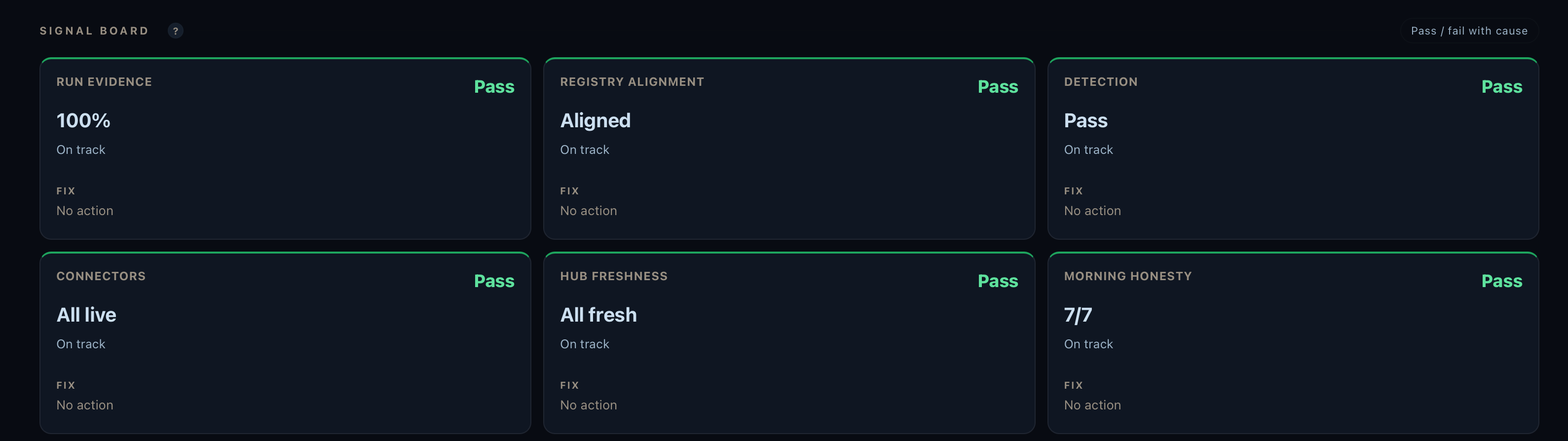
The signal board is where I spend sixty seconds when I am tired. Not because each card is interesting. Because the cards are independent. Run evidence can pass while hub freshness fails. I needed that separation on the stale-surface morning. Proof and fleet were not the lie. Freshness was.
Models produce noise cheaply. Judgment is deciding what becomes true on Wednesday morning. Observability is the layer that keeps those two things from swapping places.
Two numbers that mean different things
The other place the page almost lied was subtler, and I only caught the distinction because the stale-surface morning had already made me suspicious of single percentages.
On screenshot day both numbers were honest at once. The desk SLO was the daily gate: jobs that had to prove themselves before 7:25 AM with completed status and evidence attached. One hundred percent meant the morning gate cleared.
The registry number was the whole automation catalog, daily through quarterly. Sixty-nine percent on a Wednesday did not mean the plane was broken. It meant most weekly and quarterly jobs were not supposed to run that day.
I had conflated those scopes once and treated a normal weekday as regression. That is how false alarms erode trust as fast as false greens. The page now keeps both numbers visible so scope does not get smuggled into a single percentage. On screenshot day the split was the proof that the rebuild worked: the desk gate cleared, and the registry number stayed low for the right reason.
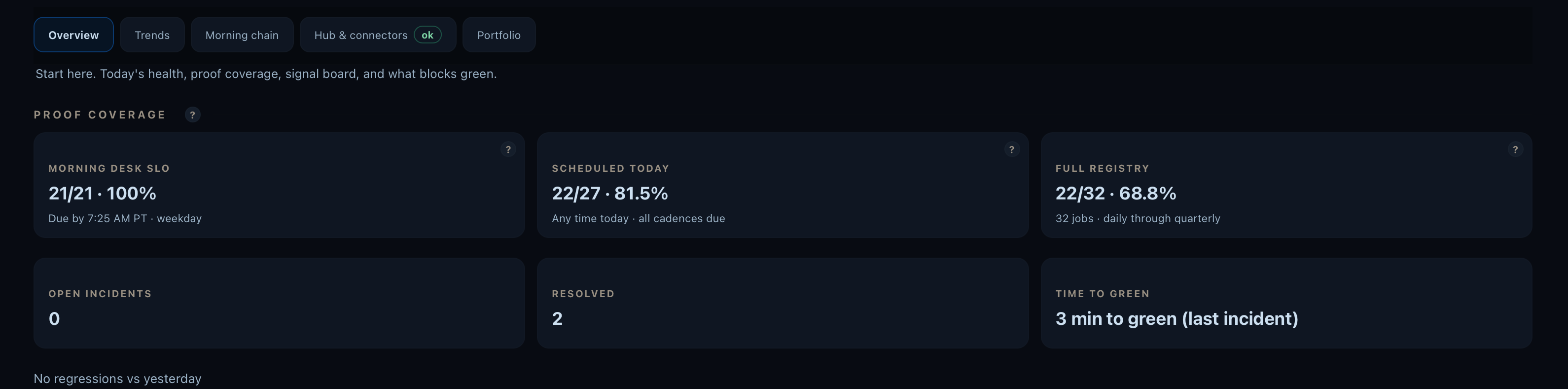
I'm still not fully comfortable with how easy it is to misread that pair if you are scanning too fast. That discomfort is useful. It keeps me on the page long enough for the contracts to do their job.
What changed after the rebuild
By the time I took the screenshots, the page was doing the boring job I built it for.
Run evidence at 100% on the desk gate. Fleet 10/10. Registry aligned. Connectors live. Hub pages fresh after the hygiene refresh. Morning honesty at 7/7. The banner said what I needed to hear: no blocking work before the brief.
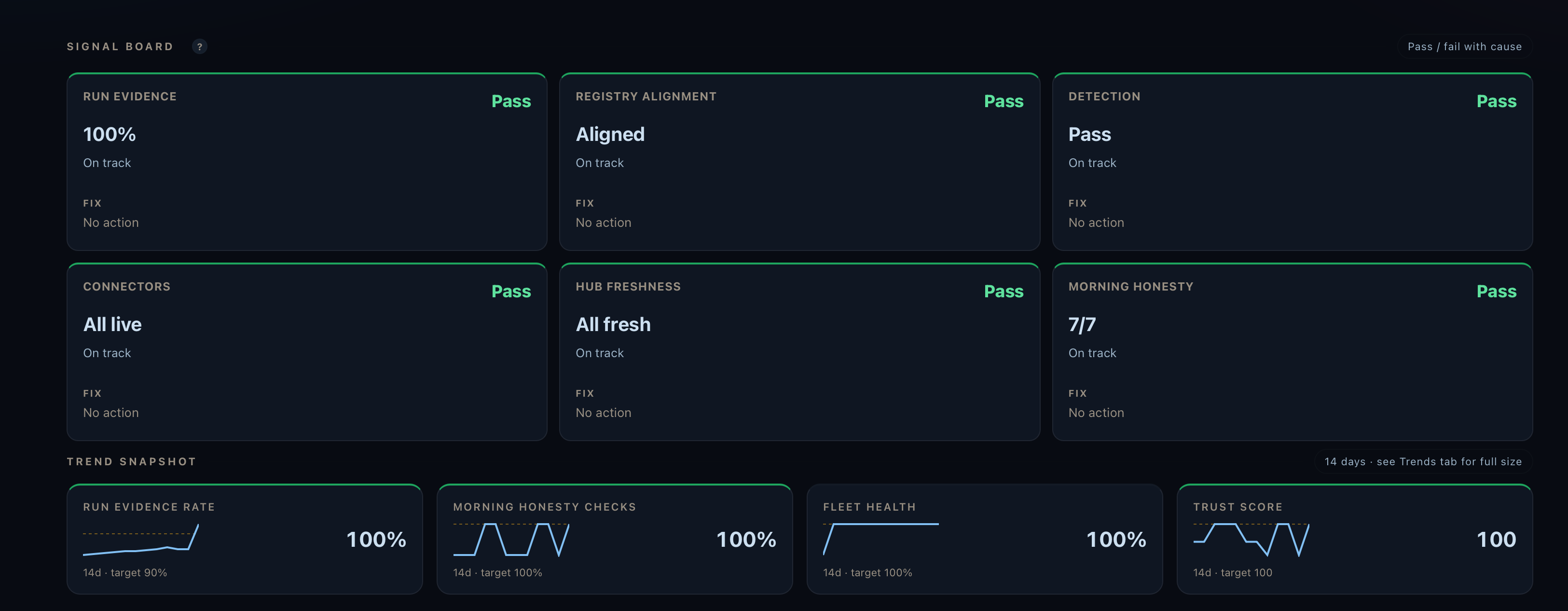
I took the screenshots after that pass, not before. That sequencing matters. The green state is not a permanent personality for the page. It is the output of a morning where the checks ran, one of them failed, and the failure got cleared before judgment moved on.
That is a quieter win than a demo applause line. I did not feel smarter. I felt less exposed.
The morning now reveals whether I am safe to lock, not whether the stack looked busy overnight. When something fails, the page tells me which contract broke and what has to be true before green is real again. When everything passes, I stop reconstructing truth by hand.
I still have three windows open some days. The difference is I no longer treat their confidence as proof. The page gets the last word before the brief does.
Key takeaways
Agent Control Plane observability proves scheduled AI work using durable run records and evidence links, not chat transcripts.
Five contracts translate trust into pass-or-fail signals with cause, fix, route, and done-when context.
Morning desk SLO and full registry coverage answer different questions and must not be conflated.
Stale surfaces can read healthy in proof and fleet signals while a canonical page is still out of date.
Explicit failure modes include silent omission, false green, split brain, stale surfaces, and proof gaps.
Observability sits on top of ownership rules; proof without write discipline audits chaos.
Frequently asked questions about Agent Control Plane observability
What is Agent Control Plane observability?
Agent Control Plane observability is a daily dashboard that aggregates proof, fleet health, trust verdict, schedule drift, and reports hub freshness into one morning-readable surface with named remediations when signals fail.
How is observability different from an Operator Control Plane?
An Operator Control Plane assigns ownership across AI runtimes through identity, Active Writer rules, and audit separation. Observability proves that ownership model is working day to day by auditing runs, evidence, and fleet signals.
Why show lower registry proof when desk proof is at one hundred percent?
The full registry includes weekly, monthly, and quarterly automations that do not run on every weekday. Morning desk SLO is the daily trust gate; full registry coverage measures catalog breadth across cadences.
What are the five contracts?
Authority, Proof, Detection, Canonical alignment, and Certification. Each maps to a pass-or-fail condition derived from trust audits, proof gap checks, fleet health, hub freshness, and morning honesty checks.
What failure modes should a control plane watch explicitly?
Silent omission, false green, split brain between schedule sources, stale hub surfaces, and proof gaps where runs complete without evidence URLs.
Can observability run without a system-of-record ledger?
The design assumes a durable ledger for runs and evidence links. The dashboard is a read surface; producers fail closed when canonical data is missing rather than inventing green state.
I help product leaders at complex product organizations unblock execution when their decision architecture starts breaking down, so that they can ship the roadmap they committed to without another quarter of explanation.
If this sounds familiar, you're not alone.
The work is not about moving faster. It is about preserving judgment as systems scale.
If you are building an AI stack and proof is getting fuzzy, book a Relevance Check. We will walk through what you can move first.
No pitch. Just the read.
Clinton Pracher | CP Product Advisory